A while back, Vinnie had an idea.
Vinnie, for those that don't know, is the robot brain behind Dreamation, Dexcon and a host of other nerd events in northern New Jersey. I've talked in the past about how good Dreamation and Dexcon are, and a lot of that is a reflection on how hard Vinnie works.
These conventions have historically been hotbeds of game design activity - a place to run playtests and to talk with designers of small press games. The problem is, the streams don't always mix well, and this came to a head at a previous convention, when confusions between what was play testing and what was actually a game to play interfered with some people's experience.
So, Vinnie pitched the idea of peeling off some of this and creating a designer-centric convention, one explicitly for playtests, discussion groups, seminars and roundtables. There was a lot of support for the idea, but a lot of uncertainty regarding what such a thing would look like. I admit, I shared in that uncertainty.
This past weekend was that convention: Metatopia. We got to see how the idea translated into reality, and from my perspective, it was very nearly miraculous.
I drove up very early Saturday morning, so I missed some of the fun on Friday night (including a panel of Ken Hite and Fred Hicks talkign about how to steal from other games) but I got two full days of goodness in. I didn't know quite what to expect, but I jumped in enthusiastically.
There were three major activities at the convention: Seminars, Playtests and Focus Groups.
Seminars are what you would expect: one or more people talking about some subject or other. This doesn't sound like much, but it's worth noting that the sister conventions have historically had a fairly anemic seminiar track. The reasons for that get a bit chicken and egg, but the bottom line is that it was really nice to see good seminars with enthusiastic attendees. It was good enough that I want to see what I can do to help with seminar tracks at Dexcon & Dreamation. It also provides a double excuse to try to drag Chuck Wendig back - we totally need to get him to talk about writing.
Playtests are also reasonably self-explanatory. Designer shows up with a game, runs it, and gets feedback. These are interesting because their value really depends on the GM's attitude. For GM's who came into it looking to really tear into their own game to find what made it work, it was a godsend, and you could spot those GMs because they were the ones making changes in response to play experience. For GM's who felt they had a finished game, I think it was a lot less useful - fine tuning is something you do over time. The feedback you could get at this convention was more suited to the guts of your game than the chrome.
This actually kind of hurts as a designer, because I'm not sure how to provide feedback on it, especially when it's clear there are problems with the game. Even moreso when it's clear the problems maybe things the designer is already married to. I don't want to discourage people from playtesting their game in this context, but if you're not ready to be told your game doesn't work, it's probably not helpful.
The last (and most interesting to me) were the focus groups. These were for people who had an idea for a game, but not necessarily much more than that. You sit down in a room and talk about your game and your ideas, and you proceed to brainstorm. For folks who've attended the Indie Roundtables, it's rather like that, but more focused. I LOVED these, and I wish I had done more of them - something to make a note for next year.
Anyway, there's a lot more to talk about, but for everyone who has wondered, I just wanted to make sure you had a sense of what this Metatopia thing is.
(I should also add, enough people at the con had nice things to say about the blog that I'm now feeling guilty about my half-assed writing schedule, so we'll see if that can be fixed. Also, if you attended my seminar (thank you!) I'll be posting my notes soon, probably as tomorrow's post.)
Monday, November 7, 2011

Friday, October 28, 2011
What We Want
What we want in a game is a lot like what we want in life. I’m gonna riff a bit here on David McClelland via Peter Bregman with the list of desires that drive us:
- Achievement (To compete against increasingly challenging goals)
- Affiliation (To be liked/loved)
- Personalized power (influence and respect for yourself)
- Socialized Power (to offer others Personalized power, which is to say, influence and respect)
Now, there’s no one point I want to make from this, mostly because I think there are dozens of points to be made from it, so it’s important to me to lay this out as a foundation, because it makes subsequent points easier to discuss, so with that in mind, let’s run through these.
Achievement
Achievement is probably the most obvious, since it lies at the heart of the game part of most games, and it’s intimately tied to things like advancement, encounter design and so on. It’s important to call out that there’s a reason this is achievement, not challenge, because challenge is only a part of it - it’s the increase that is truly critical. Our brains thrive on mastery - we get a buzz from learning things and overcoming difficulty, but only the first time. If we’re faced with the same problem again, it quickly bores us. If we’re faced with an utterly different problem, that might be fun, but the sense of progress is not there. It’s counter-intuitive, but the best reward for success is a greater challenge.
This is one reason we’re so attached to character advancement in games, because it’s the easiest way for a GM to ramp up challenge. Without advancement, the GM needs to either push harder every time (as you would in a non-RPG as you progress in competitive ranks) or get very creative.
Now, I should note that there’s a lot of leeway in terms of what the challenge is, and that interacts pretty strongly with what Achievement needs. Fight scenes are challenges, and they’re the sort of challenges that advancement speaks to, but if the challenge the player seeks is creative, that requires a very different sort of ratcheting effect to keep increasing challenge.
Affiliation
Hopefully, this is largely obvious - it’s a big reason we play these games rather than write fiction to similar effect. The social element of play is huge, and not to be underestimated.
However, in my experience this is also a big part of satisfaction in play. One of the rules of design behind a lot of Evil hat decisions is that everything should have a face. Settings are made most interesting by the imaginary people in them, because the fact that they’re imaginary doesn’t really keep us from forming strong attachments to them (as can be evinced by the message boards of any fandom). Play that provides opportunities to scratch the affiliation itch is going to be satisfying play.
Personalized Power
Well, duh.
Ok, maybe it’s a little more complicated than that - step back a minute and consider what power means. It means the capability to accomplish things, to make things happen. It’s the ability for your action to have a measurable, noticeable outcome. It’s the ability to shape the world through your actions. When we have this power, it is a great feeling, and when we are denied it, it can be frustrating beyond measure.
Now, the first instinct is to look at RPG characters and drawl a line to their obvious power. Throwing lightning bolts, lifting cars and cutting through hordes of monsters are such clear expressions of power that they’re the first thing the mind goes to, but in doing so, it misses the mark. Certainly, that sort of blatant power is fun, but it is not in and of itself satisfying.
The real power of an RPG character is the ability to act. Part of this is implicit in the structure of rules (you roll the dice and something is going to happen) and some of it is implicit in adventure design (it’s a poor adventure where there’s not much to do) but taken as a whole, it’s an ability to simply do things which we often lack in our day to day lives. In real life, there are complication. Doing things is slow and boring, or our situation may not allow us to impact things that matter to us. In games, we can act. We may not always succeed, but just being able to try is empowering.
Lightning bolts and flaming swords just make that ability to act more colorful. It’s the action that is power.
Socialized Power
This one is probably the most interesting because while it’s probably the most poorly served by games in general, it’s possibly the most powerful when a game makes it go, because in play it’s most often reflected by as making other people awesome, which is (to my mind) one of the best things that can happen at a table.
The real meaning of this is something that could take up multiple posts of its own, but one interesting thing about socialized power is that it is hard to do without affiliation and personalized power, since it’s the fruitful combination of the two (it’s possible, but doing so tends to be more like martyrdom than a healthy dynamic). As a result, it can take more work to achieve, and it’s benefits are probably the least obvious until you have tasted them.
There’s more to say, but at this point it starts turning to how these points interact with games at the table, and that’s fodder for future posts.
Monday, October 24, 2011
Playability in Settings
Setting is, to my mind, utterly essential to RPGs, and has also been the poor cousin to rules design in a lot of the deeper discussions of RPGs. I’m not entirely sure how to address that, but I think a good start involves looking at setting design with the same eye we’ve applied to rules, and see what we find.
On my mind at the moment is the question of what makes a setting particularly playable. This is not the same thing as what makes a setting good or compelling, and in fact, a good, compelling setting can end up making a very good game even if it has no elements that make it more explicitly gameable.
While this is far from a comprehensive list, these are the elements that float to top of mind for me.
Communication
Unless the setting implicitly keeps the entire group of characters within shouting distance (something dungeons do) then they need some means of staying in touch. In the absence of this, you can end up with difficult pacing problems if the game starts going one particular direction without one or more players participating. Communication (and its companion, ease of travel) is the solution for this. Modern games have an easy solution to this with cell phones, but things like Amber’s trumps can fill this purpose as well.
As a paradoxical bonus, the presence of a communication element is necessary to make the absence of communication into a plot element. Running from zombies and trying to find cell signal is something you can’t do in 1974.
Recovery
If your game is going to have any amount of violence, then you need some way to keep long hospital trips from bogging down the game, you need some logic to address this. It might be a genre thing (as in cinematic or supers games), or it might be an element intrinsic to characters (like Vampires and Amberites) or some easy means of healing (like spells or some magical substance); whatever the form it takes, the real purpose is to keep play moving.
The exact means of recovery may also be a plot element in its own right, so its worth considering that this doesn’t exist in a vacuum.
Social Context
This can take a lot of different forms, but it is best described as characters having a role in the setting, something that has a context beyond themselves, but still of an understandable scale. A family or secret society might fill this roll, but a nationality won’t because it’s simply too big.
The litmus test for this is whether or not it helps answer questions about what the character does and has done “off camera” and how well armed they are to answer questions and make decisions without a full GM briefing. That may not seem intuitive, but consider that the social context provides resources with faces - people who you can talk to and turn to in complicated situations. Not only is that play generating, it creates a virtuous cycle where that play reinforces social ties, which in turn allow fodder for more play.
However, one needs to be careful to keep contexts playable. It is structurally better to have everyone within the same context, or at least within one context, otherwise the context draw away from play. Consider the problem when every player is an agent of a different group - you can construct something artificial to tie them together, but it’s tricky to maintain. Easier to either use different groups or subgroups. Consider these examples:
- In Vampire, characters were members of their clan, but they were also part of the political structure of their city. The latter could help bring a group together without the former completely pulling them apart.
- In Eberron, the Great Houses were really interesting and colorful, but they were potent enough ideas that they wanted to pull the game in their own direction. Unfortunately, because it was paired to the power system, it was easy to end up with things pulling apart.
- Amber has the family has an overarching group, but it has numerous shifting factions and alliances within that group.
Mobility or Position
This is not literal mobility (though that has a place, as noted under communication) but rather social (or social-ish) mobility. Characters need to have the opportunity to change their situation through their own efforts. Partly this is something that helps buy into the context of the setting, but it’s also a big avenue for player-generated plots - if they have something they want that they can get, then sooner or later they’re going to get motivated to go after it. It’s also worth noting that while this may interact with character advancement, there’s no guarantee that it will.
The alternative for this is to give the players position (and with it, responsibility). It’s a similar play motivator, just from the other end. People like being important, and important people have things to do.
There’s no reason a setting can’t have both of these, but one or the other will suffice.
I am by no means asserting that a game can’t be fun without these, or that a setting can’t work without them, but I know that when I sit down to scratch out a setting (or even a sub-part of a setting) for a game, these are the things I try to make sure are present.
Friday, October 21, 2011
Play is an Argument
There's a lot of discussion about what a game is, in the context of RPGs, and even when I propose an answer, I never imagine it to be the only answer. Still, it's interesting to think about.
I was chewing on that today and considered a slightly different approach - a game (or rather, the act of play at any given moment) is an *argument* about how things should turn out. I suppose it might be nice to call it a negotiation, but I think argument is a better word since positions tend to be put forward forcefully and while there may be movement towards compromise, that is far from a necessity.
The important and potentially powerful point to this perspective is that it suggests that individual perspectives on what a game is become arguments within that context. To illustrate this idea consider that "Because it makes the best story" is a powerful argument, but it's not the only argument.
More familiar arguments include the sort of things that might be described as crunchy minutiae, like how many inches of plywood a desert eagle can shoot through. You get similar issues with strongly held opinions about setting or character elements - "My Guy" syndrome falls under this, but all manner of setting and genre expertise matters fall under it as well. Turning to an external arbiter (like dice) is another kind of argument.
These arguments are almost certainly familiar to every gamer out there, and while some might characterize them as problematic arguments, but I am pretty confident that the real confusion stems from another source. It's not the arguments themselves that create a problem, it's the certainty associated with them. As in civil discussion, certainty creates all manner of problems in coming to resolution.
Now, every group has their own biases regarding what makes a good argument, and so long as the group is in agreement regarding what arguments are and aren't fair game, then things will probably go well, provided those expectations are looked at, thought about, and communicated well.
I admit my own bias is to bring as many arguments as possible to the table, though I obviously fall victim to my own tastes, often without realizing it. I admit it can make things more complicated, but I find a lot of benefit in apparent contradictions. And more, it can become habit - looking at every argument, every time can seem like a lot of work, but the more time you spend looking at different arguments, the more arrows you have in your quiver when it comes time to resolve things (either as a player or a GM).
Everway had a great method for this, explicitly calling out three arguments out as Karma (stats), Drama (needs of the plot/story) and Fortune (draw of the cards). It was a fantastic muscle-builder for me as a GM, and I absolutely encourage a GM to try something similar, if only to see how it helps thing think about things differently.
Thursday, October 20, 2011
I Woke Up With This In My Head
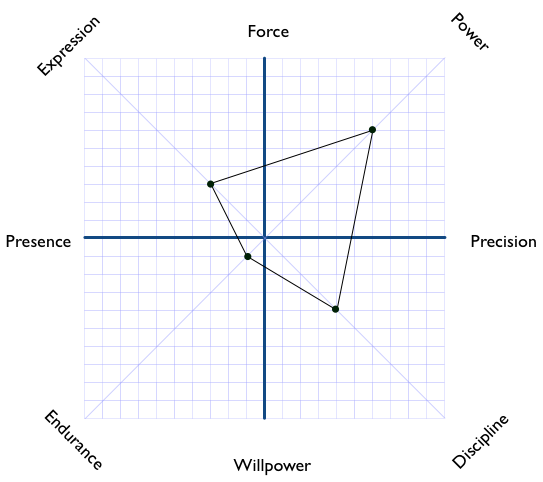
OK, what this means to me:
The assumption is a 4 stat set in the spirit of Amber. The 4 stats are Endurance, Discipline, Power and Expression, with 4 derived stats, Willpower (Discipline & Endurance), Precision (Discipline & Power), Force (Power & Expression) and Presence (Expression & Endurance).
The core model is a double-paired idea of internal/external and Active/Passive.
Power is external/active - it covers action. Action tempered by discipline is precision (a lot of stuff traditionally thought of as Dexterity) while Force is the expression of action (think Strength).
Endurance is External/Passive, though that's hopefully obvious. Presence is patient, long term interaction with others, while willpower is the combination of Endurance and Discipline. I am attached to willpower being derived because it tends to be a giant pain in the ass in play, though that's a whole other topic.
Discipline is Internal/Passive, and it's a whole topic in and of itself.
Expression is Internal/Active, which is a little weird on the surface of it, but works if you view Internal as including personality, then it becomes a nice middle-place for Charisma.
Anyway, that's the bones of it. Still chewing on it.
Tuesday, October 18, 2011
I Want To Borrow 4e's Foundation
Ok, here's an important thing about 4e that I would suggest that even die hard fans of other editions consider: it's foundation is excellent. In my opinion, it's a better foundation than any previous edition of D&D, though I leave that comparison up to the reader. But what does that mean?
I mean that if you took some characters and stripped them of classes, powers and almost everything else, you have a very solid little set of skirmish rules that strike a very strong balance between speed and depth. Boiled down to that level, it's easy to see that there are just a handful of refinements from 3e, and the line from the original dungeon skirmishing is very easy to see.
I've steadily come to realize that the thing that keeps drawing me back to 4e is the simple power of that foundation. You could build entirely different games on top of it which could be entirely awesome. Different stats? Different classes? No classes? No Powers? Totally different power models? it would be easy to build such a thing on top of that chassis to capture almost any flavor or style of play that you want.
See, that's the thing about the classes and powers as they exist: they represent a decision about how the game should look and feel. This is not a bad thing - the designer's vision is a large part of the reason you buy a published game - but because this look and feel is so striking, it creates a sense that it's the foundation. That is, it's easy to look at 4e and think that if you want to change it, you should change powers and classes. 4e makes it feel like those are low-level changes while they're actually quite high-level.
I don't think this is good or bad in and of itself, but it mingles interestingly with the other realities surrounding 4e, specifically it's semi-openness (which encourages high level tinkering) and it's model of game-as-web-service (which discourages many types of tinkering). Altogether, it reveals my frustration - I want to take that foundation out and play with it. Doing so is how you can get awesome things like the (very much not open content) awesome of Gamma World.
But that's not an option, at least not for anything public. I suppose it might be possible to build it forward from pathfinder or to create something similar from scratch, but both of those feel like inelegant solutions. But I want to find a solution, and I can tell you why:
I want the game I can _make_ with 4e.
Stop for a moment and consider what happens when you start looking at all those powers in 4e as building blocks for a simpler game. If you're starting from scratch, unbound by what's at-will, encounter or daily, then you can build almost anything using these parts and a little duck tape. Like spell points and spell lists? Make a list out of a set of thematically similar powers, and give them mana costs. Don't like encounter and dailies for non-magical characters? Adopt a system where lower level encounter powers become higher level at-wills. Want to make power sources more important? Maybe come up with new ways to recharge dailies? It all opens up.
Obviously, I can already do this at home, but I'm a social guy. I like sharing. And that - the game I can make with the 4e parts - is the game I wish I could be sharing.
Friday, October 7, 2011
Uniquely Qualified
Nothing breaks my heart more than when I hear a GM complain that he wishes there were more roleplaying in his game. It's tragic because it's always so heartfelt and sincere and is almost always followed by said GM then introducing his new combat showpiece, hardcore dungeon crawl, or puppet show on rails. It hurts because the problem is so self-evident yet apparently completely unseen.
The solutions can also be painful, as the GM attempts to introduce "roleplaying encounters" into a game which neither wants nor needs them, but that attempt at a solution is emblematic of the problem. The idea that these other elements of gaming are somehow contradictory to roleplaying is pretty much entirely false. It's a case where there's plenty of correlation, but the cause is something else entirely.
Now, certainly there are some challenges - system mastery takes time and effort, and during the learning period, it's hard to focus on anything but the game. Sometimes a GM extends this period by following the path of the hard core - by constantly upping the challenge through increased mechanical complexity, he can extend the learning period indefinitely. That's a problem, yes, but not a problem with the games. Even the most complicated of games can reach mastery equilibrium in a reasonable timeframe with the right group or GM (or both).
But the real problem is the idea that the crunchy, fighty dungeon crawl is at odds with RP. It's nonsense, but it's deeply rooted nonsense that owes a lot to the history of the hobby and especially the history of published adventures. After all, books and movies can be full of high adventure and still support banter, character development, drama and so on - why is it a problem for games?
To understand the issue, let's take a moment to look at the heroes of fiction, especially adventure fiction. Generally speaking, they're presented with a challenge or challenges which they must overcome - not unlike adventurers. But the important part, often overlooked in gaming, is that part of the reason that the fiction is about these characters is because they are uniquely qualified to handle the challenge.
This idea of unique qualifications is a broad one because there are a lot of different things that make for UQ, and in fact in most fictions, the UQ is usually a result of a specific combination of non-unique qualifications. To illustrate that, consider that qualifications tend to fall into one of four loose categories - capability, knowledge, care, opportunity, and capability.
Capability is the first thing most gamers will think of. It means the hero is capable of tackling the problem either in the specific (he has the key to a specific lock) or in general (the problem is dangerous and he's badass). In gaming terms, we tend to jump right to thinking about this in terms of powers, skills and levels, but it can be much more nuanced.
Knowledge means that the hero sees the problem, often where others don't. Notably, it doesn't mean the hero knows _how_ to solve the problem - that's a form of capability - only that there's a problem to be solved.
Care means that the hero has a personal investment in the problem, a stake in the outcome which they're invested in. It might be because the problem affects them or those in their circle directly, or they might have a strong position on this particular type of problem. Care ends up being a kind of capability in certain types of fiction, especially noir detective stories - specifically, the protagonist has some moral backbone that allows them to pursue the problem rather than be consumed by the moral failings that surround him, like corruption.
Opportunity is, predictably, the opportunity to address the problem. It might be as simple as an issue of being in the right time and right place, but it might be part of a tangle of available time and conflicting responsibilities. Opportunity can muddle with capability very easily, especially when you start taking about authority or social position. A king can do a lot of things (capability and opportunity) but he may be bound by law (limit of capability) or unable to act due to other duties (lack of opportunity).
Look at any adventure fiction you like, and you'll find some combination of these in the protagonists. Sometimes you'll even find different combinations in different protagonists, and that can be pretty cool, but these unique qualifications provide implicit motivation and engagement for heroes in their own adventures.
Now, contrast this with the bog-standard dungeon crawl. At first blush, it looks like it demands several qualities - monsters must be fought (Capability), there's treasure to be gained (a kind of care) and the dungeon is conveniently nearby (opportunity) but they fall apart when you start looking for uniqueness.
See, by design, a published adventure needs to be able to be run through by any group of adventurers of a certain size and level, which means that, by design , it will demand no unique qualifications of adventurers (except perhaps those which it creates within its own bubble of fiction). Any other group of adventurers could do this (so much for capability), the reward is probably quite fungible (not much care left) and that leaves only opportunity. But thanks to the nature of geography and gaming, odds are good the dungeon of your level is going to "just happen" to be where you can get to it, so that feels like a fairly hollow oportunity.
But the problem is not dungeons! Not even super hard core crunchy ones. The problem is bad habits of framing. If you're a GM who wants to see more RP, then you need to start making the dungeons more engaging, and to do that, you need to figure out how to make the dungeon something that your specific group is uniquely qualified to address. Start from that foundation of generic threats and generic loot and start making it personal. Give your players a reason why _they_ are the ones going into this particular monster filled hole.
You'll find that RP emerges very naturally from that engagement, whatever system or style of play you use.
Subscribe to:
Posts (Atom)