Showing posts with label Design. Show all posts

Monday, October 24, 2011

Playability in Settings

Setting is, to my mind, utterly essential to RPGs, and has also been the poor cousin to rules design in a lot of the deeper discussions of RPGs. I’m not entirely sure how to address that, but I think a good start involves looking at setting design with the same eye we’ve applied to rules, and see what we find.

On my mind at the moment is the question of what makes a setting particularly playable. This is not the same thing as what makes a setting good or compelling, and in fact, a good, compelling setting can end up making a very good game even if it has no elements that make it more explicitly gameable.

While this is far from a comprehensive list, these are the elements that float to top of mind for me.

Communication

Unless the setting implicitly keeps the entire group of characters within shouting distance (something dungeons do) then they need some means of staying in touch. In the absence of this, you can end up with difficult pacing problems if the game starts going one particular direction without one or more players participating. Communication (and its companion, ease of travel) is the solution for this. Modern games have an easy solution to this with cell phones, but things like Amber’s trumps can fill this purpose as well.

As a paradoxical bonus, the presence of a communication element is necessary to make the absence of communication into a plot element. Running from zombies and trying to find cell signal is something you can’t do in 1974.

Recovery

If your game is going to have any amount of violence, then you need some way to keep long hospital trips from bogging down the game, you need some logic to address this. It might be a genre thing (as in cinematic or supers games), or it might be an element intrinsic to characters (like Vampires and Amberites) or some easy means of healing (like spells or some magical substance); whatever the form it takes, the real purpose is to keep play moving.

The exact means of recovery may also be a plot element in its own right, so its worth considering that this doesn’t exist in a vacuum.

Social Context

This can take a lot of different forms, but it is best described as characters having a role in the setting, something that has a context beyond themselves, but still of an understandable scale. A family or secret society might fill this roll, but a nationality won’t because it’s simply too big.

The litmus test for this is whether or not it helps answer questions about what the character does and has done “off camera” and how well armed they are to answer questions and make decisions without a full GM briefing. That may not seem intuitive, but consider that the social context provides resources with faces - people who you can talk to and turn to in complicated situations. Not only is that play generating, it creates a virtuous cycle where that play reinforces social ties, which in turn allow fodder for more play.

However, one needs to be careful to keep contexts playable. It is structurally better to have everyone within the same context, or at least within one context, otherwise the context draw away from play. Consider the problem when every player is an agent of a different group - you can construct something artificial to tie them together, but it’s tricky to maintain. Easier to either use different groups or subgroups. Consider these examples:

  • In Vampire, characters were members of their clan, but they were also part of the political structure of their city. The latter could help bring a group together without the former completely pulling them apart.
  • In Eberron, the Great Houses were really interesting and colorful, but they were potent enough ideas that they wanted to pull the game in their own direction. Unfortunately, because it was paired to the power system, it was easy to end up with things pulling apart.
  • Amber has the family has an overarching group, but it has numerous shifting factions and alliances within that group.

Mobility or Position

This is not literal mobility (though that has a place, as noted under communication) but rather social (or social-ish) mobility. Characters need to have the opportunity to change their situation through their own efforts. Partly this is something that helps buy into the context of the setting, but it’s also a big avenue for player-generated plots - if they have something they want that they can get, then sooner or later they’re going to get motivated to go after it. It’s also worth noting that while this may interact with character advancement, there’s no guarantee that it will.

The alternative for this is to give the players position (and with it, responsibility). It’s a similar play motivator, just from the other end. People like being important, and important people have things to do.

There’s no reason a setting can’t have both of these, but one or the other will suffice.


I am by no means asserting that a game can’t be fun without these, or that a setting can’t work without them, but I know that when I sit down to scratch out a setting (or even a sub-part of a setting) for a game, these are the things I try to make sure are present.

Wednesday, October 5, 2011

Roleplay and Exploration Rewards

I was struck by a tweet this morning regarding the difficulty with handing out XP awards for exploration and roleplaying, specifically, that such rewards are arbitrary and hard to rightsize. This immediately struck me as a very valid complaint, but also one that's very easily addressable - it's just a matter of identifying the behaviors and experiences to reward, then plugging them into the reward system. For illustration, I'll be using 4e to show how to do this (primarily because it's standard reward model is very robust) but the basic idea can be used for almost any XP-driven game, especially ones with the idea of an encounter.

For purposes of awards, I'm going to provide a loose definition of both roleplaying (as a specific subset of play) and exploration. RP is, practically, engaging some element of the setting. This may seem like a strange definition if your first thought is that it's talking in a funny voice or getting very emotional at the table, but those are just ways to go about engaging the setting - that is, ways to meaningfully interact with the setting as if it matters. This can range from involved conversations with NPCs to hard choices about the fate of nations.

Exploration is a little bit easier to quantify - it's the process of adding something to the mental (and sometimes physical) map of the campaign. When the players explore The Dungeon of Doom then they get certain rewards just for being there (assuming that there are fights and challenges in a place called The Dungeon of Doom) but they have also added TDoD to the landscape. In the future, new enemies might take it as a lair, or maybe people will try to reclaim it. It's now a thing, and that makes it part of the campaign. Exploration is the process by which these things (which might properly be people, places or things) get added to the game.

These two elements may seem difficult to standardize for rewards, but they share a common idea which can tie this all together. Both rotate around the idea of campaign elements - either engaging them or adding them - and it's not difficult to systemize that. All it takes is a list.

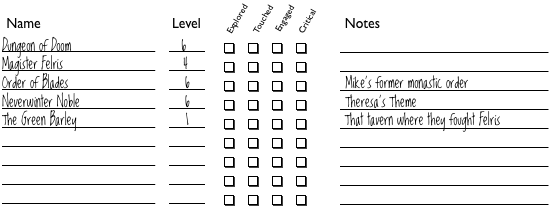
I'm going to call this list the Game Log for simplicity sake, but the name isn't important. What matters is that it's a list of the elements that come up over the course of a campaign. It will grow over time, and it provides a valuable resource for GMs, both to handle XP awards and to provide a little inspiration when designing adventures. The log looks like this:

sample.png

(You can download a PDF of the form here)

Using the Form


The Name column is for the name of the element. Elements might be anything that can recur in a game, limited only by the taste of the GM. This includes locations, NPCs and organizations, but it can also include character elements. Themes (as presented in the Neverwinter campaign setting) are another great example of a possible element.

Just keeping a list like this is useful to an GM, and most of us already keep it in one form or another, if only to answer the "Ok, who was that guy with that thing that one time?" kind of questions that pop up during play.

The level is a little bit less obvious. While it's tied to the idea of character level, it does not have exactly the same meaning. Practically, level is a measure of how important an element is, with the most important elements having a level equal to the current level of the characters. Mechanically, this is tied to XP rewards (we'll get to that in a second) but it also is a useful way to keep track of what is an isn't used in a campaign.

Generally speaking, when an element is introduced, it will probably be at the character's current level. It may "level up" any time it is engaged (see below) but it shouldn't go beyond the character's current level unless it's something the GM really wants to emphasize. That's the default assumption, but there are a few tricks that can be played - GMs looking to experiment in allowing players to introduce elements in play may allow them to do so, but start those elements out at level 1, and force them to grow in importance through play.

The checkboxes are for use in play, to indicate what's happened. "Explored" is the most straightforward - you check that box the same time you add something to the list (or, if you already had it on the list, when the players first encounter it). An element should only be explored once in its lifetime, so once this box is checked, it stays checked.

The other boxes - Touched, Engaged and Critical, see a bit more action. When an element comes up in play, you check the box that corresponds to how it came up.

If it was a memorable but unimportant part of play, then check "Touched". This is appropriate if an NPC was visited, a scene happened at a particular location, or the players talked about a thing.

If it was a noteworthy part of play, then check "Engaged". The line between touched and engaged is a bit subjective, but that's an intentional nod to GM taste. In general, something should be considered engaged when it provided a strong motivation for play or created a cost or a choice. If the players had to have an extended negotiation with an NPC or their favorite bar burned down, that would be engaged.

One trick that comes in handy is looking where else rewards are coming from. if the negotiation with the NPC is also a skill challenge, then the negotiation itself may not merit an Engaged tickmark (though it probably merits a "Touched") but if the skill challenge _also_ engages the players and characters, then yes, it totally merits a check.

"Critical" is like engaged, but moreso. If the interaction is particularly central to play, or is a turning point in the campaign, then Critical gets checked. The GM will probably know when a Critical interaction is coming, since it's usually a result of the GM doing something awful to or with the element, but it's possible to be surprised, and this is what to check if your players really blow you away.

The notes field is, as you might expect, where you keep notes. Hopefully self explanatory.

The Form and Rewards


At the end of a session, you should have a few checkmarks that indicate the things that your players found and engaged. Turning that into a reward is based on the idea of a standard award, and this is why I use 4e to illustrate.

The standard award is an amount of XP equal to that given for a monster of a given level, in this case, the level of the element (I told you that would come in handy). The basic idea is that an "Explore" or "Engaged" checkmark gets the standard award, while a "Touched" checkmark awards a fractional reward, and a "Critical" result provides a bonus. In 4e terms, these line up roughly with a minion and an elite (so 1/4x and 2x respectively).

Thus, for example, let's say that the players interact with a level 4 elements.
For discovering the element, they gain 175 XP.
If they touch on it, then the award is 44 XP.
If they engage is, then the award if 175 XP.
If engagement with it is critical to the game, then the award is 350 XP

Note - Only give the highest award, though you may give an exploration and engagement award if both seem warranted.

Run down the list, tally the awards, pool them, then divvy them among the players. Simple as that.

Notes and Thoughts


Exploration Games: You can change the proportions a bit if you want to emphasize or de-emphasize exploration. If exploration is critical to the game, then the reward for an explore tick might be as much as 5x a standard award.

Long List: So, what keeps the list from getting crazily long? While GM editorial oversight (especially the decision whether or not something goes on the list or not) plays a role, then I suggest the following trick: After an element gives its exploration award, drop its level to 1, and let it level back up in play. This means that players will get better rewards for working within a smaller list than they will by constantly having things get added, which nicely simulates the conservation of characters and locations you see in most fiction. It also provides the GM a handy tool that reveals which elements the players actually care about based on which ones get leveled up.

Personal Awards: Note that this model explicitly rewards the entire group equally for roleplaying, and I admit that's something I very strongly endorse, but on the off chance that you want to reward star players, then it's a fairly simple matter of noting the star performer in the notes column, then not adding the reward for that element to the pool, and give it directly to the player.

Slightly more complicated is the issue of personal character elements - that is, should everyone get rewarded when a given character's theme becomes important to play. My answer is a profound "yes", but if that is not to your taste, then you may consider some elements to be "owned" by a specific character, and have the reward go directly to that character rather than into the pool.

But I really suggest against it. Not only does it introduce the bookkeeping hassle of mismatched XP and the social hassle of rewarding the loudest players, it removes the incentive for players to celebrate each others awesome. If only you get rewarded for your character theme, then only you will look for ways to hook it in. If everyone is rewarded for it, then everyone's looking to bring it into play. That's a vastly preferable arrangement in my mind.

Other Systems: As noted, while it's easiest to do this with 4e, if you can figure out the standard award for your game, the model translates easily enough. Heck, you can even do thematic versions. For example: for a white wolf game, I'd forgo levels in favor of rating things from 1-5 dots and just be a little more stingy about how they level up.

Thursday, September 1, 2011

Tunnels and Trenches

Played more Deus Ex, though curiously that has not really been what's been eating my time. I've really grown to appreciate it's design of creating multiple paths to success, and what's most interesting to me is that those paths remains mostly obscured unless you're the kind of player who cheerfully spends time poking into every nook and cranny (which I am).

But the thing that's impressed me is something that resonates very well with adventure design. There's an old saying which I think I heard from S. John Ross, that a mystery should be like a maze - confusing if you're in it, even if it's obvious from up above. I've always liked that comparison because it speaks to one of the biggest challenges to the GM in designing coherent adventures - the GM is always looking at the maze from overhead, so it's hard to really wrap your head around what it looks like from within.

A lot of bad habits come from this, and two of them in particular are a poor sense of difficulty (that is - "my players are such idiots, why can't the see the obvious!") and railroading ("There's a path out of the maze, I just need to get them on it!").

Now, there are a lot of solutions to these problems, and I've talked a lot about flexible ones such as might be used in Leverage, but if you like your structured adventures, there's still something interesting to do about it. Thats where Deus Ex comes in.

At first my GM's instincts twitched in the face of Deus Ex mission design. Sure, it was great to have it be objective (rather than process) driven, but when you started looking around, you realize there are SO MANY ways to approach a problem that it seems unfair - it's _too easy_. But at the same time, I was impressed at how tidily the various approaches knitted together to feel organic.

The piece I was missing was that the organic feel was a natural offshoot of their being too many options. Even if there are multiple paths of approach, the player will only experience one, and by virtue of doing so, it will feel right. There's some interesting thinking there - if we figure out to do some clever jumping to get somewhere, we credit the designers for foreseeing that. And, heck, maybe they did, but more likely, they didn't stop it.

See, that's the real trick - though there are multiple paths to the goal, what really makes them work is that the player can change paths at will. You are not compelled to keep sneaking even if you have been sneaking up to this point.

This is the point that intersects with adventure design interestingly. There's a tendency in structured designs to dig tunnels - single paths to the destination. A "flexible" design might have multiple discrete tunnels, but discrete is the operative word. Writers and GMs will regretfully accept the necessity of this approach because, without a tunnel, there's no telling which way the characters will go.

A game like Deus Ex forgoes tunnels in favor of trenches. The trenches all flow towards the end point on various routes[1] which the player can easily follow, but they are also easy to step out of and into a different trench. The net effect is a sort of mesh design which has some fascinating emergent properties. Specifically, by making the process through them non-procedural, it feels more player driven and organic, and provides opportunities for meaningful out-of-combat choice and strategy. Yes, all trenches may get you where you're going eventually, but you can still be smart about picking which ones to follow.

Anyway, I have more to play, and I expect it to continue to be fun, but I just want to plant that idea in your ear: Mesh Design. It's worth a try.


1 - How do they do this? By being built _out_ from the goal. Building a maze from the outside in is a novice mistake.

Tuesday, August 23, 2011

A Noun is a Person Place or Thing

I love the Discworld novels. They're fantastic, and I enjoy the heck out of them, but like many fans I am partial to a particular subset of them. In my case, I'm a huge fan of the City Watch books. Nothing else comes close (except perhaps the Moist von Lipwig stuff, which I'm willing to acknowledge as a fair second). Now, there are many reasons I love these books, but there's a particular element about them which I think is very relevant to setting design.

See, I should also note that I'm a big fan of cities. I have purchased city books for games I will never play because I'm always fascinated to see how people present cities and urban adventures. I am, by and large, disappointed. The bulk of city products tend to be a handful of really interesting pages about the shape of the city, then piles and piles of pages that turn the city into some sort of above-ground dungeon.

Now, thankfully, this is less common with more modern products (and as noted, the recently released Neverwinter Campaign setting is not half bad) but what's gotten me thinking is the difference in how Ankh-Morpork (the city of the City Watch novels) is presented. Certainly, there are a handful of places (The Unseen University, the Watch House, the Opera House, the river Ankh, Guildhouses and so on) but the city is primarily defined by trends and people.

Now, people are kind of an obvious part of things, albeit one that is often undeserved in setting design. It is possible to design a setting that is almost entirely characters, but it's trickier to do it in a way that preserves player agency. That is, there is a strong tendency for a character-based setting to become about the NPCs rather than the PCs. This is where the Forgotten Realm soften go wrong, and it's where Amber often (but not always) went right by firmly tying the characters to the setting NPCs.

Trends are a little more interesting, because they apply to people and to places equally. They're the answer to broad, semi-specific question - where would a high class scribe work? How do people on the street respond to a mugging? Things like that. I can answer those questiosn about Ankh-Morpork because they're the parts that get detailed in the books much more than the specific drilldown of street addresses.

The thing is, most good city books have this information, but they tend to present it in a very different manner. They provide raw data from which a savvy reader might be able to extract trends, but only rarely do they make that leap of abstraction themselves.

Now, I'm a firm believer that one of the most useful things a published setting can do is let the GM answer when a player wonders "What's here?" It's a good, often relevant question, and I've seen a few products that have sustained the level of detail to actually be able to answer it explicitly (The Birthright campaign setting for one, the old Thieves of Tharbad city book for MERP for another) without being ENTIRELY overwhelming, but it's a lot of work.

The alternative would seem to be to arm the GM with the understanding to know the answer, or to create an answer that is consistent with the greater whole. But how do you convey that without a series of bestselling novels? The answer, I think, demands experimentation.

(Oh, and we will be getting back to prep in 4e, but let's just say that one is a many-headed beast)

Friday, July 29, 2011

Skills

Ok, enough combat for now. We'll need to come back to it after other things have evolved a bit more, but I feel like we've got enough of a foundation to work with. That brings us to something that's potentially even stickier: Skills.

Broadly speaking, skills are going to be what distinguishes one dice pool from another. That may seem like a very pedestrian, gamey way to describe them, but in practice it's the purpose they ultimately serve outside of the game space. Inside the game, in the fiction, there's obviously a bit more to it than than, but to someoen watching your game, they're the reason you rolled 5 dice instead of 3.

There are a lot of different ways to handle skills lists. There's the traditional skill list, where you create an actual list of skills which - hopefully - covers everything a character might do and let players buy from it. There's the broadly descriptive model, where players simply take descriptors (like Cop, Soldier or Pastry Chef) and use those values for anything that fall under the auspices of that descriptor. There are hybrid models that use a short list of broad descriptors to be all encompassing. And we've only scratched the surface - we haven't yet considered, stats, pyramids, simple and advance skills, specialties, descriptive vs. narrative pricing, implicit skills and many many other things.

All of which is to say, there's no right way to build a skill system. Use what you're comfortable with and you'll be fine, but if you try to present it as somehow inherently superior to other models, you mostly reveal your own ignorance. I think the skill model I'm going to pursue is clever, and I like it because it does some novel (and some less novel) things, but it's no great apex of skill design.

The system starts from two datapoints: I like cultural skills and the system has been designed so a d6 is a valid value. For the unfamiliar, cultural skills are a bit of an idea riffed from Over the Edge, where you had a 2d6 in anything you should normally be able to do. It's a super practical rule, but when you try to move the OtE system to another setting, you find yourself asking what "normal" is when you start comparing elves and dwarves. With that in mind, I want the starting point of every character to be "[Culture] d6".

Now, it will probably be pretty easy to figure out what that means, and if that was the only skill then it wouldn't really be much of an issue, but obviously we're going to need to start slicing things thinner. And that's where things are going to get a little bit fiddly, since I'm not going to let skills improve.

That sounds draconian on the surface of it, so let me explain a bit. The character's [Culture] skill will never be higher than a d6, but he can learn more specific skills at a higher level. However, rather than making a fixed skill list and letting people buy up it (So one guy might be Swordsman 2d6 and another might be Swordsman 4d6), I'm going to make the scope of skills narrow as they go up. That is, 1d6 skills (of which [Culture] is the only example) are SUPER broad. Any skill at 2d6 is still going to be very broad, but not as broad as culture. As such, Merchant, Soldier, Noble and so on are all valid 2d6 skills.

Each tier narrows things further. At 3d6 might be Musketeer or Doctor. 4d6 might be Fencer and Neurologist. 5d6 narrows down to a specific specialty, like rapier or diseases of the brain.

Obviously, each of these must be built on a foundation. So you need to have Culture to get Soldier, Soldier to get Musketeer and so on. These higher level containers create natural limiters on the flow of skills, so you don't just get "Rapier 5d6" out of the blue.

Now, this is a good start, but there's one more twist to it that I haven't touched yet, and this is the really crazy bit, but it's going to have to wait until next week. :)

Thursday, July 28, 2011

The Hard Questions

Ok, the remaining questions:
  1. How many dice should it take to offset a status?
  2. Who gets to say what form the status/result takes in the fiction?
  3. What order do things happen in?
  4. How big an advantage is 1 die?
  5. How does this map over to multiple combatants?
These are some of the hard ones.

How many dice should it take to offset a status?
I touched on this earlier, and one commenter gave some useful breakdown, and the short form is that this is a surprisingly tricky question. If this number is fairly low (say, 1 die per) then it makes dice differences more potent because it makes it easier to smooth out any short term advantage that a smaller die pool might have achieved. Not sure if that's good or bad, but it's important to know.

This also plays interestingly into the question of how target numbers are rolled for, because there is some question as to whether and how players can -try- to recover. This is not totally black and white, since I think it might not be unreasonable to say that if you really want to focus on recovering, pick something other than attacking (with a target of 4) and do that.

Lastly, we get some interesting effects if the pricing is inconsistent. Damage could become "stickier" if it becomes more costly to remove (or reduce) a status.

But in that, I think we might have our answer - reduction. If the "cost" is 1 die per 1 step reduction (rather than total removal) then it has two interesting effects. First, it makes it harder to clear the board - totally removing a severe effect - so the more severe the effect, the more implicitly costly it has become. Second, it means that even with mitigation, the accumulation of statuses is dangerous. That is, if you are already inconveniences and harmed (or whatever) then you can't just bump a taken out result down 1 to save yourself - you need to remove it entirely.

There's also some asymmetry to deal with. The steps for inflicting a status are big, so leftover dice are going to be more common than statuses, and that's a problem, since it invites fights that never end except at the very high and very low skill ranges. Some of that will hopefully be mitigated by other things you want to spend overage dice on, but that's a weak prop.

So with all that in mind, I think the right answer is to make the price consistent, but slightly higher - Allow 2 overage dice to reduce (but not remove) a status.

Who gets to say what form the status/result takes in the fiction?
Touched on this yesterday, and for the moment, I'll stick with the target defining things (with the possible optional rule of allowing the attacker to define things with a higher roll).

What order do things happen in?
Ah, now there's a bit of a bear. Initiative.

I cannot think of an initiative system I've ever actually liked. Round robin works ok, so it's all the way up to tolerable. Speedy action based ones (Shadowrun, Deadlands) make me crazily stabby. Shot Clock ones (Feng Shui, Exalted 2nd) always seem promising in theory but always prove more work than they're worth in practice. I could totally cheat the whole issue and go for scene based resolution or some other abstraction to escape the question entirely, but I don't actually enjoy things like that (with the exception of how The Shadow of Yesterday handles it, which I'll probably steal).

The reality is that I'm probably going to be forced to go with some sort of round robin/turn taking model out of brutal necessity, but I don't have to like it, and I can work to avoid things like "Declare up, resolve down" because part of what I'm trying to avoid is the big pow-wow between each round of combat. If action isn't fluid then it's less fun for everyone.

Honestly, initiative is one of those areas where I really prefer GM instinct and dicelessness. That is to say, while numeric initiative totally makes sense when everyone is part of the big picture (as in the case of, say, a tactical minis skirmish) that's not how fights work in fiction or perception. They are lots of miniature stages within the large picture, and we (as audience) move from one to another according to the cadence of the fight. A good GM can use "initiative" as that audience, moving from place to place according to the logic of the fights, not according to some numeric counter. Doing so covers a multitude of sins, allows for characters with different levels of combat focus to get different levels of attention while still keeping the spotlight from lingering too long in one place.

But that's not something you can really write a rule for. That's a problem.

So, honestly, my take on it is to make the official rule very simple - literally just go around the table rather than do any weird rolling or anything - but provide guidelines for initiative as cameraman. Mechanically, we might allow some rules for speed tricks using unused dice or the like, but those are for exceptions - character for whom speed is a schtick. In the absence of that the role of initiative is to keep everyone playing and engaged, not to reward the guy who found the best mechanical abuse of the system.

How big an advantage is 1 die?
Pretty big. In the end, if a 1d advantage means an 80% chance of success, I'll be happy. Obviously, there's a sliding scale to this - 3d should beat 2d more reliably than 5d will beat 4d, but that's my ballpark starting point, with a roughly 10% margin of error. However, I expect abilities (ways to spend dice) will throw this off when I get to them, which is fine.


How does this map over to multiple combatants?
This is the most important question to apply to any combat system. It is not hard to come up with a brilliant, clever, intricate system for handling 1-on-1 fights which utterly fails to account for multiple actors. Some of them try to apply duct tape solutions, like trying to make everything into chained sets of duels or aggregating opposition, but you can see the seams when that happens.

There's also an important genre consideration to how numbers work. I hate to invoke realism, but I'll do so in this very broad context - being outnumbered sucks. One man can absolutely fight a larger number of opponents, but doing so is dependent on a lot of factors, most of them involving finding a way to keep them all from coming at him at the same time. This is important, not because of how you model tactics, but because it's very important to _society_. It's what makes armies and police and many other things work. It also matters to style. The number of people one guy can fight speaks directly to the genre of things. In a gritty setting, even badass will run from groups of lesser adversaries, but in very cinematic settings, those adversaries are probably mooks, and can be easily dispensed with.

I'm definitely looking to avoid mook rules, though that's a whole other discussion of it's own. They're easy to add if a specific genre demands it, but I don't want them as a baseline. I like ganging up to be dangerous because of the aforementioned social element (and, in fact, this sentiment is all over the Fate 2 combat rules) but I think I may have implicitly handled that already. Since status mitigation depends on excess dice, the simple reality is that multiple opponents are going to burn through your dice in no time at all, even if they're not hugely dangerous individually. That's just a gut answer for now, but I think it will do.

Wednesday, July 27, 2011

Fighting Questions

Ok, getting into some of the nitty gritty here, so let's review.

The idea so far is that combatants will have die pools of D6's. When they go after someone in a fight, they are trying to hit a fixed target number, with a result as follows:

4 - Inconvenienced
7 - Harmed (possibly handicapped. Maybe another term)
13 - Taken Out

These are statuses which map to in-fiction effects, and they also accumulate, so an inconvenienced character who is inconvenienced again becomes harmed.

Statuses can be changed by spending unused dice. Unused dice are dice which have been rolled, but which were not necessary to hit the target number. If, for example, you rolled 4,3,3 then you can hit a 7 with 1 unused die (or a 4 with 2 unused dice) which you can use for stuff. Much of the stuff is currently undefined (and is expected to be a place for mechanical hooks) but specifically, they can be spent to "downgrade" statuses.

With that in mind, I'm looking down the barrel of the following questions:
  1. Does the attacker choose the target number he's going for, or does he simply take the result?
  2. When a status "rolls up" does the previous status remain? That is, if a second inconvenience becomes harm, is the target now inconvenienced and harmed, or just harmed?
  3. Is there an option to respond to a Taken Out result?
  4. Are statuses the only possible outcome, or are they simply the non-specific outcome? That is, is a disarm a _form_ of harm, or something with a difficulty equivalent to harm (because it has a similar impact but with player-directed outcome)
  5. Are 3 statuses enough? Do we need 4?
  6. How many dice should it take to offset a status?
  7. Who gets to say what form the status/result takes in the fiction?
  8. What order to things happen in?
  9. How big an advantage is 1 die?
  10. How does this map over to multiple combatants?


That's a lot. Enough to tempt me to just accept a standard injury model and move on, but I'm kind of dumb that way, so let's press on and work through these, though it may take a while.

1. Does the attacker choose the target number he's going for, or does he simply take the result?

Ok, two options: decide before you roll (declare intent) or declare after you roll ( describe outcome). The argument for post-roll is that the assumption is that every attack is an attempt to finish the fight. It also opens up an interesting decision-point of allowing the attack to choose to get a lesser outcome in order to keep more unused dice. That is, if you rolled 4,1,1,1 then you might feel better off taking the 4 and three unused dice (which probably need a cool name) than taking the 7 with no remaining budget.

The argument for a pre-roll decision is that it adds a little more strategy to the mix. It makes risk-taking a bit more of a calculated gamble, and it does _not_ require any post-roll decisionmaking. That's kind of a big deal, since post-roll decisions are a big source of friction - you totally don't want a player sitting there deciding if he really wants that 7 or those unused dice on a borderline case.

So, there's a clear priority conflict here with no clear answer. I think either option could work well, so it's really a matter of taste, style and (of course) subsequent testing to see which works. It's one of those situatiosn where you make a decision, but put a pin in it to come back to. With that in mind, I'm going to go with decision before the roll because I think it will be easier to test whether that feels frustrating than it will be to test if it's what people want.


2. When a status "rolls up" does the previous status remain? That is, if a second inconvenience becomes harm, is the target now inconvenienced and harmed, or just harmed?
The default assumption in most systems would be that the effects stack - that is, that you would now be inconvenienced and harmed. I'm inclined to buck that trend, at least while we have such a short list of statues, because it effectively lengthens the "damage track". This might prove to be too much bookkeeping in the end, but it's what I want to try for now.


3. Is there an option to respond to a Taken Out result?
I feel like there should be, but the real answer to this can be found in the question of sequencing. If all action is simultaneous, then this is easy to implement - just let overage dice be used immediately to mitigate an effect. Unfortunately, simultaneous action has its own drawbacks, so this question needs to be set aside until we answer the question of order of events.

4. Are statuses the only possible outcome, or are they simply the non-specific outcome? That is, is a disarm a _form_ of harm, or something with a difficulty equivalent to harm (because it has a similar impact but with player-directed outcome)
I'm strongly inclined to the latter, and as I think about it, I think the rubric may be simple. Outcomes are defined by the attacker, harm by the defender. That means that the fiction of being taken out stays firmly in the hands of the player, which is a plus. It also works nicely with the idea of hitting set difficulties, and it also supports players who are very descriptive as well as those who are not.

Curiously, this also suggests an interesting extension of the outcome ladder, which might be a little meta, but kind of resonates with me. To inflict harm AND describe it, you must hit the next target up. That is, the target for taking someone out in the way YOU want is 19. It means the "one shot kill" still exists as a possibility when dealing with very skilled opponents, but it's rare. That has some weird interplay with things when the target is already hurt, so I'll need ot think about it some more, but if nothing else it feels like a good optional rule.


5. Are 3 statuses enough? Do we need 4?
Dunno yet. But the answer to that previous question may prove a suitable compromise.


Ok, enough for today. We'll run through 6-10 tomorrow.

Tuesday, July 26, 2011

Actual Fight Mechanics

OK, so the basic non-fight component of a conflict is this: take a swing, beat a 4, if successful, the other guy is taken out.

(I like “taken out” as a euphemism because it underscores that all ways of taking someone out of a fight are roughly equal – unconsciousness, death, getting tossed overboard and the like all fall into the same bucket, and it leaves the exact color and fiction flexible. It also leaves a hook in place later to allow players to offer their own taken out outcomes if you want to avoid death in interesting ways, but that’s a matter to think about later.)

Once we’re in an actual fight, we don’t want things to be quite so quick as all that, but we still want to respect the 4+ success rule. We could go for a numeric system (hit points or the like) but let’s think of this in terms of statuses – we have this idea that a good enough roll can result in being taken out, what else might happen as a result of a roll?

Suppose that there are two other results – inconvenienced and harmed. Inconvenienced means that the other side has gotten some transitory advantage - they’ve knocked you back, rung your bell, seized the high ground or whatever. Harm is more palpable – it’s a disarm, an injury or some other major setback. And, of course, the third result (taken out) has already been recovered.

So, at their baseline, let’s map these as follows:

4 – Inconvenience
7 – Harm
13 – Taken Out

Now, that maps to our difficulties, but it raises some immediate questions. Does it mean that you need at least a 3d pool to be able to win a fight? And what happens when two people of high skill go at each other? Do they both just die? Obviously, we need to address these issues.

Now, the first is pretty straightforward, and we’ll do something that has been done in many other systems and just have damage “roll up”. That is to say, if you inconvenience someone who is already inconvenienced, they are now harmed. If you inconvenience someone who is already harmed and inconvenienced, then they’re taken out. Pretty simple. It allows high skills to get decisive results while allowing unskilled combatants to have sloppy, ugly fights that end badly.

Still brutal, though, especially since there’s no idea of defense. Skill won’t keep you standing any longer, and that’s problematic.

The fix for this is tied into how I view the statuses. Note that it would be normal to put a checkbox next to each status an fill them in over the course of a fight, but that’s more static than I like. I actually don’t want them to be static, I want them to come and go – not just inconveniences (which are already often tenuous in games like Fate) but harm and maybe even taken out. This means that, at a high level, I want people to be able to improve their status as they play, so that’s another axis of action. Sometimes it will be a dull axis (shrugging off an injury) and sometimes it’ll be flashy (getting out of a tight corner) but the bottom line is that status can fluctuate over the course of a fight.

(Saying that, my gut is suggesting we need a 4th status, just so there’s more room for things to slide. That may be true, but I’ll sideline that concern for now. If I figure out a good mechanic for this, then one good test for it will be expanding the status list).

So how should we implement this? My first thought is to make it something you can spend extra dice on (that is, for those who don’t recall, dice that weren’t needed to hit the target number). This has an interesting upshot because it provides a double incentive to go for inconveniences and harm rather than KO’s, because you’re more likely to have extra dice left, at least in theory. Of course, the fact that hitting three “4s” may be easier than hitting one 13 may also play into that. This also provides an interesting tool for NPC behavior, since the target number an NPC aims for speaks directly to their tactics, and can be a solid part of an NPC writeup.

Anyway, at the simplest you could just say that 1 extra die can reduce things by one “step”, so a hurt can become an inconvenience for 1 die, or go away entirely for 2 dice. That’s a good baseline, but it might be too easy. This is something to test, but I’d absolutely want to fiddle with different costs, including a higher base (say, 2 dice per step), or a sliding scale (1 for inconvenience, 2 for harm, 3 for taken out if apt – or perhaps the reverse!) but the idea is solid. It just leaves two real questions – how it interacts with a taken out result, and how it sequences. Those are pretty fiddly bits, so they’re best left for tomorrow.

Monday, July 25, 2011

Combat Waffles

All the previous discussion about fights also implies something that I figure I'll state outright - writing a generic combat system is a much bigger pain in the ass than writing one for a genre. So much so that most generic combat systems aren't - they are in fact implicit declarations of genre through the simple fact of how they handle things like survivability, "realism" and such.

Not to say they are unaware of this. Most provide a baseline with the expectation that it can be tweaked to handle other genre expectations (provided the game acknowledges genre expectations in the first place), but they need a starting point. So with that in mind, let's establish one.

My personal burden is that the two poles I am drawn towards in RPG combat are strongly opposed. The first is Swashbuckling, which is a bit over the top, but not as much so as Hong Kong action or Anime. The second is Rolemaster, where violence is dangerous and risky and always to be taken seriously. Those two things are hard to combine, but ideally we can pull off some sort of vinaigrette sort of emulsion.

This means the first thing to look at is stunting. This is sort of a broad question best phrased as "how tolerant is the system of players doing cool stuff that might be unrealistic or tactically inappropriate but which looks awesome?" This is a kind of important question because, practically speaking, swinging from a chandelier is a pretty awkward way to make an attack, but it looks pretty cool, so how should a game handle it?

The first option is the strict realism school, which would impose a penalty to the attack based on the difficulty of it, maybe call for an athletics roll to pull it off, and otherwise frown and tut-tut at the idea. In short, everything in the system would suggest that this is a terrible idea, and one you really shouldn't pursue unless absolutely necessary.

There's also a loose realism school which is not necessarily going to penalize such an attack so much as make it non-optimal. It might offer some small benefit (such as allowing the attack to be made with an athletics skill) for a serious tradeoff (you do unarmed damage, which probably sucks). This is something you can do, but it's rarely going to be the optimal thing to do.

At the far opposite end, you have the true stunting school (names thus for it's use in Exalted) where the character gets a _bonus_ on the attack based on how awesome it is, thus making colorful attacks desirable. This can get a little silly as players ham it up to get the bonuses, but it definitely supports the flashy.

Between those, there's a broad band of cinematic styles, ranging from abstract cinematic (like 4e's stunts, where the mechanical effects are sufficiently disconnected from the fiction to allow a lot of narrative flexibility within fairly strict mechanical interpretation. Also applies to many scene-based resolution games) to gritty cinematic (as in Feng Shui, where stunts are penalized, but that penalty is very small and bonuses are very high, which allows them but discourages their constant use).

This cinematic space is probably where I want to aim for, which is definitely on the swashbuckling end of things, but it highlights a few things. My real goal is the 1970's Three Musketeers movies, where fights have flair (and even humor), but also have a sense of danger to them despite reasonably limited bloodshed. That means I'm not looking for Hong King musketeers - it sucks in film and it's not what I want in a fight.

Part of this is tied to the cultural role of violence and death. It's important to remember that while we remember the duels and swordplay in the Three Musketeers, that was criminal activity. Duels are illegal because people killing each other is a terrible thing. It's a sin and a crime, and while you might try to outright murder the other guy on the battlefield or in certain brutal circumstances, those are edge cases. Or should be. The problem is that in any modern game, you can be certain that a player wants to be Wolverine (or the like), and such things quickly move towards the least common denominator. That's rough.

And with that, I find myself wrestling again. Is there a meaningful way to address the role of conflict in the game outside of the conflict rules? Setting design can speak to it certainly, but there's a reasonable case that they can be quite toothless in the face of a setting that says one thing and rules that say another.

Argh. Ok, I clearly need to just write some rules, then worry about this issues _after_ I do so. Doing so beforehand is proving utterly paralyzing.

Friday, July 22, 2011

What To Do With a Fight

At first glance, it can seem like the question to ask yourself when designing a combat system is "How can we have everyone kill each other?" This is certainly an important question, but I think the real question is quite the reverse. That is, "How can we keep people from killing each other?"

Why? Ok, consider most any other action in an RPG or story. You want to lift a rock? Maybe roll some dice and you lift the rock. Ditto for climbing a rope, charming a barmaid or anything else. But when the action is "Stick my sword in that guy" we're uncomfortable with it being that straightforward, and when it comes to the other guy trying to stick his sword in us, then we definitely don't want it to be that simple.

So with that in mind, the real purpose of the combat system is to make the process of killing someone take enough time and effort to complicate matters without making things un-fun. That is, I admit, a kind of callous and disturbing take on it, but the role of violence in RPGs is a bit of a messy topic (and one I'm not really going to drill into at the moment).

On the "not making thing un-fun" front, many systems put a subtle (or not-so-subtle) thumb on the scales in support of the idea that the PCs are going to win any fight they engage in, albeit at some cost. This is a tricky balancing act because we instinctively want a "Fair fight" but we also want a fight we can win. This is the sports movie paradox, and it pops its head up in RPG design in a lot of odd places. This is a big issue, but it's also a high level one, which makes it hard to address at this point.

In terms of complicating violence, the trick is that the heart of a combat system is not dealing damage, it's damage mitigation. Not that dealing damage in unimportant, but rather it's simple and straightforward, and if that's all there was to it, then combat would just be back to the straightforward "I put my sword in his gut". Mitigation is all the reasons that you can't put your sword in his gut, or that it doesn't end the fight when you do.

Classically, this divides into two things - defense and resistance - though that is a division born out of tradition more than necessity. Defense is all the reasons why something wouldn't hit you (that is to say, have no subsequent mechanical effect) while resistance is all the reasons that a hit doesn't end the fight (such as damage reduction or hit points). This sounds tidy, but historically it's very muddled. Consider the role of armor - is it a function of defense or resistance? You can make a case for both (and, indeed, in some systems it has elements of both) and in doing so you highlight the division.

There's a reason that this model lines up with a similar two-part model for offense - roll to attack + roll to damage. They're opposite sides of the same coin, and a lot of games have streamlined both of these things into a single roll to hit, with damage based on Margin of Success plus some modifier (such as weapon or strength). This is certainly easy, but it tends to encounter predictable problems. Specifically, it tends to make whatever stat covers accuracy into a super-stat, and it does weird things when dealing with weapons at extremes of the damage range (since it can make "0 damage" weapons, like a ping pong ball, lethal).

Unfortunately, the alternate approach of adding more layers of rolls (say, one for attack, one for penetration and one for damage) gets cumbersome quickly, so it's not a solution either. Practically speaking, we're limited to a small number of rolls for an exchange in combat, but at the same time we want it to be more than just a single exchange. So where does this leave us?

Well, let's look at what we have for dice. Right now, our core idea is that a normal success is easy to achieve, and there's not much that's more normal than whacking someone. This means we've got a default assumption that it's pretty easy to hit someone, and I'm ok with that, because it is. And that, right there, speaks to something of a design goal - the purpose of every swing in a fight is to end the fight, so there needs to be a good reason it doesn't.

Having a goal like that is essential to making a combat system do something other than emulate another combat system you're familiar with. That specific idea is a somewhat brutal design goal, and it won't stand on its own, but it's a great start, and it gives us something to build from for the next time.

Thursday, July 21, 2011

Combat is a Pain

Ok, back on track. Time to think about conflict. Now, the reality is that if you're designing a game, conflict really means combat. Yes, absolutely, you might need to handle other types of conflict, but combat is the starting point. This is partly because it's such a central part of the hobby, but it's more because if your system is going to break, this is where it's going to happen. That sounds negative, so let me put it a little bit differently - no other part of a game system requires you to think about what the game will actually be like and how that interacts with expectations than combat.

That's a pretty loaded statement, so let me unpack it a bit into the four things that make combat a pain in the ass.

First, because combat tends to have explicit stakes (character well-being) that are measurable outside of the fiction (stats and information on the character sheet) its impact is directly observable in action. That is, while there may be some narrative interpretation applied to how 7 hit points got lost, it's still 7 hit points getting lost. This is not necessarily true of every system out there, but it's common enough to be a default.

Second, there's a huge range in expectations regarding how combat should go, so much so that it's one of the main yardsticks for judging genre. Games might have lethal, brutal combat, or they might have fast and loose, mostly harmless combat. Or they might have something in between. Whatever the case, the usual yardstick is that there is usually a specific look and feel the designer is going for, often epitomized by a particular book, movie or TV show though sometimes through their own personal lens of how fights work "in real life".

Third, fiction (both on-screen and in-mind) has the benefit of narrative protection for heroes, allowing an author to tell a tale of brutal, unforgiving violence without accidentally losing characters. A designer who seeks to emulate that may quickly discover that brutal and unforgiving cuts both ways. This can be addressed by effectively having different rules for players and everyone else (4E and many video games do this well) but that introduces a lot extra overhead into the system.

Last, we've got decades of training from D&D that have totally shaped our perspective. This is not a sleight to D&D but rather an assertion of its huge mindshare, as can easily be seen in most RPGs and computer games. And not just CRPGs - there are precious few shooters out there that don't have some form of hit points, and there's a good reason for that. If play is fun, then dying (and thus not playing) probably isn't. On the upside, this simple model has supported a lot of fun play, but it also means that the assumptions that might guide you in other parts of game design may fail you here. The blatant gamey-ness of combat does not stick out to people the same way it would in other parts of the game, and in fact if you move away from the established standards, people start reacting badly because they know how things should be.

Now, these are concerns, but not show-stoppers. But they're important to keep in mind as we move into designing conflicts.

Tuesday, July 19, 2011

A Little Spin

Ok, so we now have a basic die mechanic (a tally system for dice pools ranging from 1d6 to maybe 5d6) and a basic method for establishing difficulties (numeric steps 4/7/13/19 based on expertise required to perform a task) and a methodology for handling success. That's a good start, but for all the thinking that went into it, there's not much there. In the absence of further details, this is just one more d6 system looking for an answer to the question of "Why not just use RISUS?"

First off, let me state that RISUS is a good answer to many questions, and if the sole purpose of this were to create a not-RISUS, that would be a little lame. There is a lot of desire in RPGS to differentiate purely for the sake of differentiation (or, more cynically, to make something different enough that you can put your name on it) so beware that particular lure.

Thankfully, I have enough things I want the system to accomplish that we still have some very organic work to do. Let's start looking at the bells and whistles.

When looking to add fiddly bits to a system, its worth thinking about when in the process you want things to happen. Are you going to introduce choices before the dice roll or afterwards? Or both? This gets further complicated when you have more than one roll (such as D&D's attack & damage) but let's not borrow trouble. We'll assume a single roll for the time being.

When making this decision it's worth realizing that there's more than just timing at work. Choices made before the roll have a very different texture than those made afterwards, and the difference revolves around the certainty of the outcome. Any choice made before the roll is, practically, a gamble. It's a choice being made on the hope that the subsequent roll will succeed. This has the benefit of being more engaging and the drawback of risking paralysis - it's easy to get hung up on what would be the "right" choice.

In contrast, choices made after the roll are very certain, and tend to be all about working with the outcome. In addition to being simpler, these choices usually are much easier to ingrate into the fiction of play. That is, characters don't use their big attack to miss - they hit, then decide it's going to be a big hit. For some people that logic is jarring, especially if the game has enough missing that it's expected, but other players find the other disconnect jarring.

So, let's say we want a before-the-roll mechanic. We probably want to embrace the gambling element of it, allowing the player to take on some risk before the roll in return for a potential reward. The easiest way to do this with the system so far is to play around with the trickle-down nature of success. Under normal circumstances, even if you don't hit the target you're going for, you still succeed to a lesser extent. You could offer a bonus on the outcome provided that failure will be absolute.

That feels a little awkward, and there are simpler alternatives. Bonus Dice, for example, are a common trick for rounding out dice pool systems. That is to say, you may get to roll extra dice, but only count the best ones. These might be true bonuses (Like in PDQ# or Over the Edge), fixed result pools (like Cortex+ always keeping the best two dice) or roll & keep systems (like L5R).

This is a pretty robust system, and has the advantage of keeping the results within the bounds of the original die pool. It's worth keeping in mind, but it's also well worn territory. I'll keep it in mind, but I'm not particularly inspired. With that in mind, I'm switching the focus to an idea for an after-the-roll bonus.

A while back, a very clever game called Secret of Zir'an failed as a result of a terrible printing failure. One of the more fun ideas it included was a very robust system for using the Margin of Success on a roll for mechanical purposes. That is, if you needed a 20 and rolled a 25, you might spend 2 points to do extra damage and 3 points to knock your opponent over. Neat little mechanic, and one I'd love to capture it.

The problem is that margin of success math is a pain in the ass. Adding up a bunch of dice is enough of a barrier - adding a second equation to the mix is just a bad idea, so the trick is to find a way to make that simple.

With that in mind, we'll try a trick that steals a page from the idea of bonus dice, but keeps the focus on the margin of success. The player may "keep" however many dice he needs to make the roll - if there are dice left over, then those can be spent as currency. It doesn't matter what the values on the extra dice are - the dice themselves are currency.

For example - let's say you're rolling 4d6 trying to hit a 7. You roll 2, 2, 3, 4. You can build the 7 out of the 3 and 4, with 2 dice leftover. Those two extra dice can be spent for extra effects (akin to Dragon Age's stunt points). I don't yet know what the points will be spent _on_, but I think that gives enough of a starting point to start hanging some bits off of.

Now, it's important to remember that these bonuses need to be tangential, not additive. That is, no number of bonuses should be able to turn a 4 result into a 7, which means the bonuses don't make the result _better_, they add additional elements to it. In the most broadly narrative sense, each bonus might be used to declare a fact of some sort. This is a fuzzy distinction, but it gets concrete when you start building specific rules - it's easy to look at any specific bonus and compare it to what a higher roll would have done, and see if there's any overlap.

Curiously, this little test also sheds a lot of light on what needs to be thought about in a conflict system, so we'll probably head that way next.

Monday, July 18, 2011

Failing Failure

Looking at last weeks post, math-oriented folks have probably noticed the diminishing likelihood of failure as die pools increase. Since the absolute worst you can roll is all 1s, once you have 4 dice, you're guaranteed success. Some people might look at this as a bug and propose an easy fix, like "All 1's is a fumble", but I think understanding it requires looking at how the system handles failure.

In this case, I'm against it. Failure, that is.

This is not just a competence-porn issue, it's part of how things stay fun and interesting. This is not to say failure can't be interesting - it absolutely can - but it's rarely interesting all by itself. Failure is interesting because of the complications it introduces into the situation, and I'm all for skipping the middleman and jumping right to the complications. That is to say, if the dice come up short of the target, then it becomes a choice - would the player prefer to fail, or would he like to succeed with some complication or consequence offered by the GM.

This is easy to apply to basic difficulties (4), but how does it apply to higher levels of difficulty. Can a character take on enough consequences to successfully perform brain surgery?

Obviously, that's pretty nonsensical, so the rule of thumb is that consequences can improve the outcome by a single step, and only if there's a reasonable narrative for it (the player can male proposals if he likes). Depending on the scope of the activity, the task might be resolved in some way other than the initial skill rolled if that makes sense to the consequence. For example, if you need a computer program(7) but only roll a 5, then you might get a success by:
  • Having someone else do it, in return for incurring a substantial (and immediate) debt to them. The program might even be held hostage for you holding up your end.
  • You spend all night copy and pasting scripts from websites and you get you program, but your computer is now totally compromised by the various viruses to downloaded in the process.

None of that would help if your goal had been to design a circuit board(13), because that's a 2 step jump.

Having decided when and how failure happens, it's important to also talk a little bit about what failure means. Specifically, some thought needs to go into how re-trying works, and what the impact of failure is. In situations where the situation provides clear context for failure then that's easy, but the situation is not always clear. Looking at the circuit board example, that seems like a task with a very soft failure scenario. If you don't successfully design the circuit board, then why not just try again?

My thought is that if the task is one where the character can keep rolling til it works, then you're not rolling to see if ti works, you're just rolling to see how long it's going to take. That's reasonable, but only if time matters in the context of the game, which it often does not. But if everyone's cool with that being the case, then no problem.

However, some rolls don't invite that. There are situation where you want failure to stick, in which case failure is a demand for following a different course of action, mechanically handled by trying a different skill or by changing (perhaps improving) the situation enough to merit a re-roll.

With that in mind, the trick will be to communicate clearly to players whether they're facing a soft or hard failure. In the case of a soft failure, success is inevitable, and the roll is a shorthand for how many rolls its going to take (see the note on duration, above). In the case of a hard failure, there will be consequences of failure, and either the effort cannot be simply re-retried (or if it can, consequences stack).

So, with that in mind we know how to roll, how to judge difficulty and how to handle failure. That covers the basics. Now it's time to put some spin on it.

Friday, July 15, 2011

Difficulty with Difficulties

Ok, so yesterday we established that we’d be looking at a d6 tally system with a baseline difficulty of 4. We want to expand on that so as to better handle a die pool of up to ~5d6. Given that, there are two different vectors of approach here. The first is the purely mechanical, while the second is conceptual, speaking to the role of numbers. They weave together, so let's five in from one direction and see what comes of it.

First, we'll start with numbers. Now, one great thing about d6 systems is that the numbers are pretty well known, and there are decades of games trying to come up with interesting fixes to smooth out the progression of the average roll, since that troublesome 0.5 makes life complicated. These decades are part of why, as I noted yesterday, 4 is such a magical number. And the good news is, there are a few other magical numbers.

The first candidate is 7. 7 is a great number for two reasons. First, it's the likeliest outcome of a 2d6 roll, and second, it's the first roll that's outside of the possible scope of a 1d6 roll. That latter is handy because it provides a fantastic model for something that may not be hugely difficult, but which requires training to be able to accomplish. For example, even if you know how to use a computer (1d6) you don't necessarily know how to write even a simple program. That requires specific knowledge and training - you're not just going to "get lucky" if you keep trying. That's exactly the kind of scenario where a difficulty of 7 is a handy tool.

After that, the next magic number depends on how you look at things. 13 has many of the same benefits of a 7, except that you need at least 3d6 to hope to hit it. The difference is that it's a bit less likely to succeed - 13 on a 3d6 is harder to hit than a 7 on 2d6. Now, this might suggest a compromise middle step of 10, since that's a midpoint on 3d6, and it's +3 from 7 and -3 from 13, and given that 7 is 4+3, and 4 is 1+3 (1 being guaranteed success), there's some numerical elegance in making the progression 4,7,10,13 (especially because it can be expressed as "base difficulty of 4, with quality of success increasing by one 'step' for every extra 3", something similar to what's done in a few other dice pool systems).

The problem is there's some conceptual roughness to it. I mean, yes, I could easily say:
4 - Mundane
7 - Difficult
10 - Complex
13 - Boggling
or something equally pithy and it would still be better than a lot of games (which set their baseline too high) but really it would be utter bullshit. Those terms are crazily subjective, and while I don't object to the GM interpreting situations, they provide the GM no practical guidelines for how those things are actually set, which would be irresponsible of me.

But if we drop the 10 we get something that's not quite as intuitive a progression, but is one that gives us a real, concrete basis for the progression: the numbers are such that if you are not at least operating at a certain skill level, you can't hit them. That means 4,7,13 (and 19, if we really feel it's necessary).

Now, what those things will mean are going to vary depending a lot upon the specifics of the skills, and when this ends up in a system, some of that is going to have to be offloaded, but the basic progression is pretty simple.
4 - Normal. The difficulty for day to tay tasks that might be difficult, but require only familiarity with the action being accomplished. For example: Disinfect a cut, perform the Heimlich maneuver.
7 - Expert. Difficulty for a task which cannot be accomplished without at least some proper training and experience. For example: Perform more advanced first aid (proper splints & bandages) or give CPR.
13 - Master. Difficulty for a task which requires intense, specialized training. Example: Perform Surgery, prescribe drugs.
19 - Past-master. Perform a hyper-specialized task. For Example: some sort of specialized medicine, like brain surgery or the like.

All of which is to say, the difficulty levels are built on a clear understanding of "Do Not Try This At Home". If this is something that anyone with a little familiarity could do with luck or hard work, then difficulty is 4.

Now, I should note that I view success as trickling down. If you hit a 7, you also implicitly hit a 4, which may suggest certain bonus or not, depending on the task. If you are doing neurosurgery (19) and roll a 17, then the failure is in the specialized part of the activity. In contrast, if you rolled a 12 (lower than needed for less complex surgery) then the problem was with the surgery as a whole. You get a lot of meaning trickling down through the tiers.

Also, doing this implicitly folds in duration of activity. Climbing a mountain is a task anyone could conceivably accomplish(4). Climbing a mountain in an afternoon probably requires training and experience(7). If you roll to climb the mountain and roll a 6, you still successfully climb the mountain (you beat a 4) but it's going to take you longer than an afternoon (since you didn't hit the 7).

Now, this is still just a starting point. We still haven't added in fiddly bits, and we haven't subjected it to the real test - a conflict system - but this seems like a solid start.

Thursday, July 14, 2011

Mored6

As I step into creating a die system, lets run through a few things I like and dislike, since these things will obviously impact the final product.

1. I want a reliable/predictable measure of the dice to be rolled. Anyone who has read this blog knows I love Cortex+, but my big complaint with it is that I need to pack _all_ my dice to play. Not because a given roll will use them all, but because I have no useful way to predict which dice I'm going to need in what numbers. This may be a small and petty thing, but there's a practical underpinning to it.

2. Next, I want to use d6s. There are some practical underpinning to this - they're ubiquitous and familiar - but it's also strongly aesthetic. I own lots of cool looking d6s that beg to be used.

3. I want the difference between skill levels (or whatever they end up being) to feel substantial, and I do not need more than 5 or 6 tiers of capability. This is a cinematic/fiction driven sensibility based on the fact that such broad distinctions make for solid character shorthands and are easily recognizable.

Up til #3, all of the options were on the table, but that last step there is going to make a count system problematic. Count systems may have very coarsely grained outcomes (based on number of successes) but the actual die pools tend to progress smoothly, with only moderate differences between pool sizes, especially at high levels. I could work around this limitation with something too-clever, but that seems like a peg-hole problem.

A flat system is still technically in contention, though it would probably require stepped bonuses. For example, my cold was game handles this by making skill bonuses (on a 3d6 roll) +2, +4 and +6. Those are a little close (they work better for Fudge) but the idea of stepped bonuses is not entirely off the table.

The tally system seems like the best contender, something in the Risus/Over The Edge/WEG space, with 5 levels ranging from 1d6 to 5d6 or something similar. Historically I might try starting from a baseline of 2d6 so there's a "step down" option and there's at least a little curve in the default roll, but I'm less attached to that idea than I have been in the past.

Now, there’s still nothing concrete to make a decision on, and this can be pretty paralyzing. Almost any choice can be made to work, so what do you do?

Simple: You do -something-. I’m going to go with a tally system because as cognizant as I am of it’s flaws, I’m even more aware of the dangers of sitting here waffling. So with that in mind, let’s see what we can do with a stack of d6s.

The first thing to do is to consider difficulties. I immediately rule out contested rolls because the last thing a tally system needs is more math, so that means fixed difficulties. Since I’m starting from 1d6 I think that means I’m going to pick the classic baseline of 4.

You see 4 show up in a lot of games. It’s a pretty convenient number for a bunch of reasons. On a straight d6 roll, 4+ means a 50% chance of success, and on a 2d6 scale it’s close enough to 75% to be reliable. On a range of die sizes it’s a number that can potentially be hit by a die of any size. All of which is to say that if you’re thinking going with 4 is a ripoff of anything, realize there’s a reason for its ubiquity.

Now, this raises an interesting question: if I’m allowing 5d6 to be rolled, is a base difficulty of 4 even faintly scalable? Certainly, the apex die pools should be reasonably rare, but that’s not any kind of excuse - a known, rare problem is still a problem. Thankfully, I have an instinct that makes this a little less problematic: I’m looking for success to be the expectation. Someone with 1d6 might have some trouble, and 2d6 still has some risk, but by the time you hit 3d6 it’s very nearly a sure thing.

That said, no reason to just leave it at that. Binary success is a little dull because it offers little differentiation between activities. Teaching high school physics ends up on par with crafting the theory of relativity. So that suggests to me that adding additional tiers of difficulty is the best solution.

The problem is that difficulty steps tend to be applied very arbitrary in play. Climbing this hill is this hard, but climbing that hill is that hard and so on. I want them to mean something a little more self-evident. And that, I think, is where I’ll pick it up tomorrow.

Wednesday, July 13, 2011

Bread and Butter and Dice

Dice systems are, at their heart, kind of dull. This is probably a good thing, since most of the difference between systems can be built upon their framework, so you want them to be simple, reliable and dull. This is on my mind for reasons that are probably a different post, but I've been chewing on a core dice mechanic.

Right off the bat you have three big camps of dice mechanic. You have the flat roll, the tally, and the count. Flat roll is most famous in the various incarnations of D&D, which has used it as both roll vs. moving target (old D&D THAC0 tables) or roll + bonus vs target (4e). The "flat" roll may actually have a curve (as in the case of Dragon Age's 3d6) but it's always the same dice, and differentiations in skill are represented by changing the target number or changing the bonus. Fudge dice are another weird example of a flat roll that don't necessarily look it because the range is wacky (-4 to 4) but it's a fixed set of dice all the same.

Tally systems, such as those used in WEG's Star Wars or AEG's Roll & Keep system, are based on totaling up a variable number of dice. Variations in skill can change the size of the die pool, and while there may be some extra mechanical fiddliness in terms of how many dice are counted (as in the Case with Cortex+ or any game with bonus dice) , the core idea is that the pool of dice is the variable and as a subsidiary idea, the size of the dice may also be a variable.

Count systems are usually considered success counting systems, like Storytelling or Burning Wheel. You roll some pool of dice (of variable size, like a tally), but rather than add up the dice, you count the number of results that hit some particular criteria (such as 7+ on a d10, or 4+ on a d6). Left purely in that form, this is just a highly specialized tally system (effectively the dice have some number of 0's and some number of 1's) but it's worth differentiation from the tally because the ways it establishes differentiation can include changing the rules of success counting. For example, successes might usually be on a 7+, but in this particular area in which you excel, they might happen on a 6+. Thus, while the size of the die pool may be one axis, another will often include the means of determining successes.

There's a lot more fiddly in this. You can add bonuses to a Tally system to make it feel a little more flat-like. In any system, you can add variations in how you measure success and how you handle things like critical successes and failures (all to say nothing of rich rolling). You can get into wacky hybrids or edge cases (like set building), but those three models really cover the bulk of approaches, and they have different strengths and weaknesses.

Flat rolls are the simplest. Even when they require some math, it is usually quite simple, and perhaps more importantly it's _perceived_ as simple. Reading the die results in a flat roll is easy, with almost no learning curve. Even if the "post-processing" of adding bonuses or the like takes soem effort, it is -after- the roll, a critical point of distinction.

Tally rolls are probably the most robust. If you want to hang a million different mechanics off a roll, or make the die rolling a bit of a game in its own right (like rolling lots of dice, then doing many mini-resolutions from the pool) then this is probably the approach to take, but it absolutely runs the risk of daunting players. Even if you don't do a lot of fiddly stuff, the perception is that math is hard and slow, and tallying up the dice creates that sense of friction. This can be mitigated with small or familiar dice pools, but it's always the specter over the system.

Counts are something of a compromise. They offer much of the same mechanical robustness of Tallies, but they promise greater simplicity than doing math, and in my mind they deliver on that, at least to an extent. There can be a little bit more of a curve in picking up a count game, but the act of reading the dice is an educational one, and most people get much faster at it with only a little practice. Unfortunately, there are some problems that come with that. First, that simplicity is based on the method of counting remaining the same, and if the system leans on changes to that, it slows things down. Also, you can only rely on the simplicity scaling so far - if the dice pools get huge (like, Exalted huge) then it will still bog down.

All three methods can work very well. Even more, all three are robust enough that if there's some particular element you want to accentuate or avoid then you can easily tweak them to that end.

I'm dwelling on this because I have a dice system in mind for a project, and i want to step back and consider its weaknesses and strengths before I totally buy into it. More on that tomorrow.

Wednesday, May 4, 2011

Leveling Up To 1

There was a great discussion on twitter yesterday about what might go into a hypothetical RPG for new players based on changing 4e or Pathfinder. Lots of good ideas, but it also reminded me of another idea that I’ve been sitting on for a while, one that puts 4e through a lens of Harry Potter inspired school play.

The idea is based on a simple premise: first level 4e characters are pretty capable, enough so that it’s possible to create an arc from “zero level” to the place where a character starts play. This idea is that there’s some manner of academy for exceptional students who have the potential to “graduate” to being level 1 heroes. The exact details of the school are fodder for another post - maybe it’s a dungeon crawling academy, maybe it’s selecting future leaders of the land, maybe it’s a feeder to an even more elite school, maybe it’s something else. We’ll worry about it after the basics have been sorted out.

So how do you do this? First, start characters off with all their stats with one 8 and four 10’s and 1 12 (modified by race), 10 hit points and starting racial package of abilities.[1] All characters begin as trained in a single skill. This can be ANY skill, and this stands in lieu of a background bonus, and it is also the exceptional thing that drew the school’s attention to the kid.
Importantly, characters do NOT have all the capabilities of a first level character. Specifically, they cannot:
  • Flank
  • Aid Another
  • Bull Rush
  • Charge
  • Perform a Coup de Grace
  • Escape
  • Equip or Stow a Shield as an action
  • Grab
  • Second Wind
  • Total Defense
  • Perform any minor action (all require a move action)
  • Perform an Opportunity Attack
Characters are proficient in no armor or weapons, so even though the basic Attack action is available to them, they gain no proficiency bonuses. And, obviously, they have no class abilities, no powers, and just the one skill. Beyond that they’re basically a blank slate.

Play proceeds on that assumption, and the DC for pretty much everything the characters might do is 10, which means they’ll be really fantastic at their particular schtick, and capable at their racial ones

The model of play, then, is to follow a pattern of going to a class about some element of this (such as basic arms training) with a quirky and interesting teacher. After the class is done, they get the particular ability, and are then faced with a challenge (either an explicit school test, or some part of the plot) which makes use of that skill or set of skills. For example, after the characters have learned Aid Another, they may be faced with a challenge with an impossible difficulty (like a DC 21 for something none of them have any bonus towards) that they need to overcome.

Once the characters have gone through all the universally available things (like the actions above, as well as learning their initial feat) they may then choose a class as their academic focus, and the process will be similar, with characters learning class abilities, and eventually powers, in their classes. The goal is that, at graduation, the characters have all the abilities they would if they’d created the character at first level.

Now, exactly how many times you want to repeat this cycle is going to depend a lot on your group. Some groups might want to rip through this stuff, others might want to stretch it out. This can just as easily be a single night’s play as it can be an entire campaign, especially depending on how much you want to focus on challenges and play within the school. Whatever you decide, divide 20 points [2] among that many periods and let players spend them as they wish.

For example, a school with 4 years, two sememsters each, might do Basic combat training (Simple Weapon Prof, Equipping shields, minor actions ad flanking) semester one, Advanced training (Aid Another, Bull Rush, Charge, Grab & Escape) second semester, Focus exercises (Second WInd, Total Defense, Coup De grace, Opportunity Attack) third semester then Horizon broadening (First Feat and trained skill) fourth semester. Class is then “assigned” at the end of the second year (angst!) and we move onto more class-specific classes.

Now, part of the appeal of this is that school play is fun. It takes work to bring the school to life and bring in challenges that keep players engaged, but it’s a neat setting premise with a familiar literary base. But there is also some appeal in that you can make learning 4e a part of the process. Players can start with only a minimal understanding of the system, and with each successive challenge, they pick up a few more fiddly bits. Only after they’ve got a sense of the basics do they even need to start worrying about class abilities and powers, and at that point, they’ll probably look pretty darn awesome.

Anyway, this is obviously only half an idea. Without a solid pitch for what the school looks like, it’s got no wings. But I’ll be shocked if some of you are not already thinking “What does 4e Hogwarts look like?”


[back] 1 - You can actually start without Racial Abilities for all races and come up with progressions for them to learn them, but this requires that the GM work things out on a race by race basis, and requires some thought regarding what races are allowed in the school. This is easy to do, but it requires more bookkeeping than I can squeeze into an already long post. Humans are probably the easiest to do in this way - just delay their bonus stuff until after play has begun.

[back] 2 − 20, not 22 because 2 points bought the starting 12. And if you use some other method of stat generation, then just apply the idea rather than the specific mechanic. The improvements come steadily over the course of play.

Monday, May 2, 2011

Layout is More than Fonts

I raised a question on twitter the other day regarding summaries in RPG books. The question was, if you’re going to provide regular summaries (of rules or example), where should it go - at the beginning of the chapter, or at the end?

For context, the question came up in my mind as I was reading a game I like very much, and which looks quite nice, but has what I consider a dysfunctional layout. One of the things I found it particularly lacking in was any kind of summary of material, which is doubly a pain because the order that rules are presented in is a little peculiar. I found that I really wanted summaries, and found myself considering the best place to put them.

There were, of course, a few out of the box responses, including a small amount of dislike of summaries, but the divide in answers was interesting to me. The split came along a peculiar axis, one that should have been obvious in retrospect. Those who wanted summaries at the end of the chapter focused on readability and flow. Those who wanted them at the beginning of the chapter emphasized the importance of easy reference - finding the start of a chapter is easier than finding the start of the next chapter (assuming you remember the order) and flipping backwards, or so the thinking goes. The one or two compromise positions I encountered (such as calling out summaries in visually distinctive sidebars or boxes) were definitely trying to find a middle ground between reading and reference, but they tend to be situational at best.

This question - reading vs. reference - is one of those very sticky issues you end up wrangling with when you really get into designing a book. It’s a hard question to answer, and there’s no single formula for success, except to say that a game which does not consider both of these approaches often ends up feeling crappy in a way that it can be hard for a reader to put their finger on.

Now, personally, I am in the "Summaries at the beginning" camp, for three main reasons. The first is reference - I agree it's much easier to find this material at the beginning off a chapter than the end, though wherever you put it, it's definitely worth using layout to call it out so it's easy to find on a flipthrough. The second reason is a bit more cynical - I have read enough RPGs that I no longer trust an author's assessment of the novelty of his game. A summary skips the breathless prose and lets me make judgments for myself.

The last reason is, I think, the most essential: it's a frame rather than a review, and that helps the reader while challenging the writer. As a reader, I can quickly scan the summary and, if it's written well, with not get tripped up on terminology or basic concepts that follow. I may have some questions that the summary didn't answer, and hopefully I will find those answers in the text. The flipside of this is that writing a good summary forces the author to write good text. If there's a decent summary, then the hard question is "what else do you really need to say?" As a writer, this can be BRUTAL. Some ideas really can be conveyed very succinctly, and padding them out to 1000 words does a disservice to everyone. If the summary comes afterward, it's just a restatement and refinement, so nobody really notices that you padded. If it comes first, it frames things, and it makes it easy to notice that you're wasting words.

Now, what's crazy is that this is only a very small thing. It's a single decision among many that you need to make when you put together a book. But like many of these decisions, it has a HUGE impact on how good your book is going to be. To be unkind, even if your game is brilliant and your rules are fantastic, if you don't consciously make this sort of decision, then it can kill your game dead. I'm not saying that there's only one answer to these question - handle summaries however you think is best, for example - but if you don't think about these things then you're begging for trouble.

It can be hard for the writer to ask these questions because they have such a personal relationship with the text. A good editor will push these points, but that depends a lot on the editor's role in the project. A good layout guy can make up for a lot of mistakes of this type, but it's a shame when they have to. But the real danger is that these points pass without comment or thought.

With that in mind, it seems I might want to return to this, and run down a few other red flags and questions a designer might want to ask about how a game can and should present information. Seem like a worthy topic to folks?

Thursday, April 14, 2011

Lateral Connections

One thing that has really been sticking with me about Dragon Age 2 has been (as is so often the case with Bioware titles) the relationships and personalities of your companions. Certainly, the arc of your hero is interesting, but it is the people around you that make it feel personal and compelling. DA2 does well enough in this that a few of your companions feel like they could be heroes (well, protagonists) of their own stories, yet this does not diminish your story in the least. Of course, the conceit that your story is being told by one of them does not hurt this perception.

Translating this to the tabletop is an interesting challenge for unexpected reasons. Certainly, there are lots of ways for a GM to make NPCs more compelling, and I’m all for those, but I don’t think they apply. It is far more apt to consider the other characters to be comparable to the other characters played by your fellow players.

Through that lens, the challenge is obvious: How can you create and encourage that kind of lateral play?

For all the reams of advice about players dealing with GMs and GMs dealing with players, there’s precious little about how to drive play between players. I suspect a lot of that is a result of game books being primarily written for GMs, and thus assuming the GM-Player dynamic out of habit. A few games address this, at least indirectly. One of the most subtle and brilliant rules in The Shadow of Yesterday is that you refresh your pools with certain types of actions, but those actions MUST be social in nature. Since everyone has the same pools, there’s a mechanical incentive to go do player-initiated stuff together.

Smallville deserves mention in this regard because I cannot think of another game where lateral connections are so essential. Relationships with other characters are an essential part of your character sheet. This is mighty stuff, but in some ways its _more_ of a solution than I’m looking for. I don’t want things to be quite that explicit, but at the same time I want character issues to be drivers of play with each other, at least occasionally.

Specifically, I love the idea that character A's issue creates play for Character B (and perhaps the whole group) rather than just being something that Character A deals with. Maybe this demands that issues come with an explicit "and here's the reason I can't deal with it myself". That's a good start, but I might go even further and find a way for character B to pursue the issue because it indirectly creates a problem for character A, if only because character B is distracted. Hard to do persuasively, though.

I am not entirely sure if this is possible, but it’s a problem I’m chewing on right now, and if nothing else, it’s producing some interesting flavors.

Friday, April 8, 2011

Action vs. Adventure

I realized yesterday that my genre expectations for 4e have been skewed. I think of it (and most RPGs) as being adventures, but I think it might be more accurate to describe 4e as part of the related-but-different action genre.

What's the difference? Speaking in terms of films, think about adventure movies vs. action movies. In an adventure movie, the hero or heroes are taken out of their usual context, face an array of challenges. While many of the challenges may be dangerous, they are not necessarily fights. Eventually the hero finishes the job and returns home (or to his original context). Essential in this is the idea that the hero's non-adventure existence is important to him. Indiana Jones teaches. Jack Burton drives a truck.

On the other hand, the action hero gets into a dangerous situation because that's who they are - the guy who gets into danger. He might have the trappings of some other life, but usually that life is an avenue to action (soldier, cop, dangerous courier) or a forgettable façade (like whatever Schwarzenegger does for a living in his flicks). At best, it provides an excuse to put the character in the situation required by the story. The character will then overcome successive challenges with escalating violence. There will be elements external to the violence, but mostly they're just there to move things on to the next fight.

Now, the lines here aren't clean cut. Die Hard, for example, has elements of both, and most exciting moves pull a little bit from column A and a little bit from Column B. What's more, the genre is not a measure of quality. Action may have interchangeable Van Damme flicks, but it also has Jackie Chan. Raiders might be an adventure film, but so are the vast array of direct-to-video Rutger Hauer masterpieces. They can be done badly or well, just as in the case of a game.

4e is designed for action. It's characters are primarily defined by their relationship to action, and elements external to that are very thin at best. Their arc is one of progressive violence, and the mechanics of the game steer things that way. This is perhaps best exemplified by the primacy of fights and the shaky footing of skill challenges.

But so what?

It would be easy to stop here as some sort of sneering dismissal of 4e, but that would be a waste of effort. The important thing to me is that in understanding what 4e is skewed towards, it makes it easier to tweak it. It means that if I want to play is straight up, I might get a more satisfying experience if I am in the mental space where I recognize that these characters would be played by Jason Statham or Milla. That is to say, I would be well served proceeding under the assumption that they are not adventurers, but rather, awesome badasses.

On the flipside, if I feel that I want something other than the action movie formula, I can do it with an understanding of _why_ it is that anemic skill challenges and boring skills feel like they're not working. Knowing why they don't work (because they're designed for action, not adventure) is incredibly useful if I want to change them since I can do so with better understanding of what I'm trying to accomplish.