Showing posts with label Techniques. Show all posts

Friday, October 7, 2011

Uniquely Qualified

Nothing breaks my heart more than when I hear a GM complain that he wishes there were more roleplaying in his game. It's tragic because it's always so heartfelt and sincere and is almost always followed by said GM then introducing his new combat showpiece, hardcore dungeon crawl, or puppet show on rails. It hurts because the problem is so self-evident yet apparently completely unseen.

The solutions can also be painful, as the GM attempts to introduce "roleplaying encounters" into a game which neither wants nor needs them, but that attempt at a solution is emblematic of the problem. The idea that these other elements of gaming are somehow contradictory to roleplaying is pretty much entirely false. It's a case where there's plenty of correlation, but the cause is something else entirely.

Now, certainly there are some challenges - system mastery takes time and effort, and during the learning period, it's hard to focus on anything but the game. Sometimes a GM extends this period by following the path of the hard core - by constantly upping the challenge through increased mechanical complexity, he can extend the learning period indefinitely. That's a problem, yes, but not a problem with the games. Even the most complicated of games can reach mastery equilibrium in a reasonable timeframe with the right group or GM (or both).

But the real problem is the idea that the crunchy, fighty dungeon crawl is at odds with RP. It's nonsense, but it's deeply rooted nonsense that owes a lot to the history of the hobby and especially the history of published adventures. After all, books and movies can be full of high adventure and still support banter, character development, drama and so on - why is it a problem for games?

To understand the issue, let's take a moment to look at the heroes of fiction, especially adventure fiction. Generally speaking, they're presented with a challenge or challenges which they must overcome - not unlike adventurers. But the important part, often overlooked in gaming, is that part of the reason that the fiction is about these characters is because they are uniquely qualified to handle the challenge.

This idea of unique qualifications is a broad one because there are a lot of different things that make for UQ, and in fact in most fictions, the UQ is usually a result of a specific combination of non-unique qualifications. To illustrate that, consider that qualifications tend to fall into one of four loose categories - capability, knowledge, care, opportunity, and capability.

Capability is the first thing most gamers will think of. It means the hero is capable of tackling the problem either in the specific (he has the key to a specific lock) or in general (the problem is dangerous and he's badass). In gaming terms, we tend to jump right to thinking about this in terms of powers, skills and levels, but it can be much more nuanced.

Knowledge means that the hero sees the problem, often where others don't. Notably, it doesn't mean the hero knows _how_ to solve the problem - that's a form of capability - only that there's a problem to be solved.

Care means that the hero has a personal investment in the problem, a stake in the outcome which they're invested in. It might be because the problem affects them or those in their circle directly, or they might have a strong position on this particular type of problem. Care ends up being a kind of capability in certain types of fiction, especially noir detective stories - specifically, the protagonist has some moral backbone that allows them to pursue the problem rather than be consumed by the moral failings that surround him, like corruption.

Opportunity is, predictably, the opportunity to address the problem. It might be as simple as an issue of being in the right time and right place, but it might be part of a tangle of available time and conflicting responsibilities. Opportunity can muddle with capability very easily, especially when you start taking about authority or social position. A king can do a lot of things (capability and opportunity) but he may be bound by law (limit of capability) or unable to act due to other duties (lack of opportunity).


Look at any adventure fiction you like, and you'll find some combination of these in the protagonists. Sometimes you'll even find different combinations in different protagonists, and that can be pretty cool, but these unique qualifications provide implicit motivation and engagement for heroes in their own adventures.

Now, contrast this with the bog-standard dungeon crawl. At first blush, it looks like it demands several qualities - monsters must be fought (Capability), there's treasure to be gained (a kind of care) and the dungeon is conveniently nearby (opportunity) but they fall apart when you start looking for uniqueness.

See, by design, a published adventure needs to be able to be run through by any group of adventurers of a certain size and level, which means that, by design , it will demand no unique qualifications of adventurers (except perhaps those which it creates within its own bubble of fiction). Any other group of adventurers could do this (so much for capability), the reward is probably quite fungible (not much care left) and that leaves only opportunity. But thanks to the nature of geography and gaming, odds are good the dungeon of your level is going to "just happen" to be where you can get to it, so that feels like a fairly hollow oportunity.

But the problem is not dungeons! Not even super hard core crunchy ones. The problem is bad habits of framing. If you're a GM who wants to see more RP, then you need to start making the dungeons more engaging, and to do that, you need to figure out how to make the dungeon something that your specific group is uniquely qualified to address. Start from that foundation of generic threats and generic loot and start making it personal. Give your players a reason why _they_ are the ones going into this particular monster filled hole.

You'll find that RP emerges very naturally from that engagement, whatever system or style of play you use.

Wednesday, October 5, 2011

Roleplay and Exploration Rewards

I was struck by a tweet this morning regarding the difficulty with handing out XP awards for exploration and roleplaying, specifically, that such rewards are arbitrary and hard to rightsize. This immediately struck me as a very valid complaint, but also one that's very easily addressable - it's just a matter of identifying the behaviors and experiences to reward, then plugging them into the reward system. For illustration, I'll be using 4e to show how to do this (primarily because it's standard reward model is very robust) but the basic idea can be used for almost any XP-driven game, especially ones with the idea of an encounter.

For purposes of awards, I'm going to provide a loose definition of both roleplaying (as a specific subset of play) and exploration. RP is, practically, engaging some element of the setting. This may seem like a strange definition if your first thought is that it's talking in a funny voice or getting very emotional at the table, but those are just ways to go about engaging the setting - that is, ways to meaningfully interact with the setting as if it matters. This can range from involved conversations with NPCs to hard choices about the fate of nations.

Exploration is a little bit easier to quantify - it's the process of adding something to the mental (and sometimes physical) map of the campaign. When the players explore The Dungeon of Doom then they get certain rewards just for being there (assuming that there are fights and challenges in a place called The Dungeon of Doom) but they have also added TDoD to the landscape. In the future, new enemies might take it as a lair, or maybe people will try to reclaim it. It's now a thing, and that makes it part of the campaign. Exploration is the process by which these things (which might properly be people, places or things) get added to the game.

These two elements may seem difficult to standardize for rewards, but they share a common idea which can tie this all together. Both rotate around the idea of campaign elements - either engaging them or adding them - and it's not difficult to systemize that. All it takes is a list.

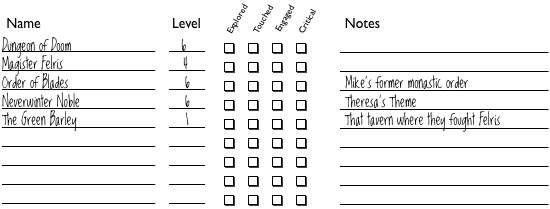
I'm going to call this list the Game Log for simplicity sake, but the name isn't important. What matters is that it's a list of the elements that come up over the course of a campaign. It will grow over time, and it provides a valuable resource for GMs, both to handle XP awards and to provide a little inspiration when designing adventures. The log looks like this:

sample.png

(You can download a PDF of the form here)

Using the Form


The Name column is for the name of the element. Elements might be anything that can recur in a game, limited only by the taste of the GM. This includes locations, NPCs and organizations, but it can also include character elements. Themes (as presented in the Neverwinter campaign setting) are another great example of a possible element.

Just keeping a list like this is useful to an GM, and most of us already keep it in one form or another, if only to answer the "Ok, who was that guy with that thing that one time?" kind of questions that pop up during play.

The level is a little bit less obvious. While it's tied to the idea of character level, it does not have exactly the same meaning. Practically, level is a measure of how important an element is, with the most important elements having a level equal to the current level of the characters. Mechanically, this is tied to XP rewards (we'll get to that in a second) but it also is a useful way to keep track of what is an isn't used in a campaign.

Generally speaking, when an element is introduced, it will probably be at the character's current level. It may "level up" any time it is engaged (see below) but it shouldn't go beyond the character's current level unless it's something the GM really wants to emphasize. That's the default assumption, but there are a few tricks that can be played - GMs looking to experiment in allowing players to introduce elements in play may allow them to do so, but start those elements out at level 1, and force them to grow in importance through play.

The checkboxes are for use in play, to indicate what's happened. "Explored" is the most straightforward - you check that box the same time you add something to the list (or, if you already had it on the list, when the players first encounter it). An element should only be explored once in its lifetime, so once this box is checked, it stays checked.

The other boxes - Touched, Engaged and Critical, see a bit more action. When an element comes up in play, you check the box that corresponds to how it came up.

If it was a memorable but unimportant part of play, then check "Touched". This is appropriate if an NPC was visited, a scene happened at a particular location, or the players talked about a thing.

If it was a noteworthy part of play, then check "Engaged". The line between touched and engaged is a bit subjective, but that's an intentional nod to GM taste. In general, something should be considered engaged when it provided a strong motivation for play or created a cost or a choice. If the players had to have an extended negotiation with an NPC or their favorite bar burned down, that would be engaged.

One trick that comes in handy is looking where else rewards are coming from. if the negotiation with the NPC is also a skill challenge, then the negotiation itself may not merit an Engaged tickmark (though it probably merits a "Touched") but if the skill challenge _also_ engages the players and characters, then yes, it totally merits a check.

"Critical" is like engaged, but moreso. If the interaction is particularly central to play, or is a turning point in the campaign, then Critical gets checked. The GM will probably know when a Critical interaction is coming, since it's usually a result of the GM doing something awful to or with the element, but it's possible to be surprised, and this is what to check if your players really blow you away.

The notes field is, as you might expect, where you keep notes. Hopefully self explanatory.

The Form and Rewards


At the end of a session, you should have a few checkmarks that indicate the things that your players found and engaged. Turning that into a reward is based on the idea of a standard award, and this is why I use 4e to illustrate.

The standard award is an amount of XP equal to that given for a monster of a given level, in this case, the level of the element (I told you that would come in handy). The basic idea is that an "Explore" or "Engaged" checkmark gets the standard award, while a "Touched" checkmark awards a fractional reward, and a "Critical" result provides a bonus. In 4e terms, these line up roughly with a minion and an elite (so 1/4x and 2x respectively).

Thus, for example, let's say that the players interact with a level 4 elements.
For discovering the element, they gain 175 XP.
If they touch on it, then the award is 44 XP.
If they engage is, then the award if 175 XP.
If engagement with it is critical to the game, then the award is 350 XP

Note - Only give the highest award, though you may give an exploration and engagement award if both seem warranted.

Run down the list, tally the awards, pool them, then divvy them among the players. Simple as that.

Notes and Thoughts


Exploration Games: You can change the proportions a bit if you want to emphasize or de-emphasize exploration. If exploration is critical to the game, then the reward for an explore tick might be as much as 5x a standard award.

Long List: So, what keeps the list from getting crazily long? While GM editorial oversight (especially the decision whether or not something goes on the list or not) plays a role, then I suggest the following trick: After an element gives its exploration award, drop its level to 1, and let it level back up in play. This means that players will get better rewards for working within a smaller list than they will by constantly having things get added, which nicely simulates the conservation of characters and locations you see in most fiction. It also provides the GM a handy tool that reveals which elements the players actually care about based on which ones get leveled up.

Personal Awards: Note that this model explicitly rewards the entire group equally for roleplaying, and I admit that's something I very strongly endorse, but on the off chance that you want to reward star players, then it's a fairly simple matter of noting the star performer in the notes column, then not adding the reward for that element to the pool, and give it directly to the player.

Slightly more complicated is the issue of personal character elements - that is, should everyone get rewarded when a given character's theme becomes important to play. My answer is a profound "yes", but if that is not to your taste, then you may consider some elements to be "owned" by a specific character, and have the reward go directly to that character rather than into the pool.

But I really suggest against it. Not only does it introduce the bookkeeping hassle of mismatched XP and the social hassle of rewarding the loudest players, it removes the incentive for players to celebrate each others awesome. If only you get rewarded for your character theme, then only you will look for ways to hook it in. If everyone is rewarded for it, then everyone's looking to bring it into play. That's a vastly preferable arrangement in my mind.

Other Systems: As noted, while it's easiest to do this with 4e, if you can figure out the standard award for your game, the model translates easily enough. Heck, you can even do thematic versions. For example: for a white wolf game, I'd forgo levels in favor of rating things from 1-5 dots and just be a little more stingy about how they level up.

Monday, August 15, 2011

Your Better Instincts

I admit that I'm usually all about taking advantage of your instincts to hose your players to make things more fun for them, but I want to take a second to turn that around.

See, while I've gotten better, one of my real weaknesses as a GM is a tendency to be too nice. If things fall apart or go horribly wrong, my instinct is to step in with my GM authority and help save the day. This is a terrible habit - I just can't stress it enough. Even if I'm not setting forth to show the players the story of my cool NPCs (which I'm not), having them step in to dramatically save the day has the same net result. My game's no longer about the players, it's now about whatever the stakes of this particular adventure are.

This is a sinister problem, in part because it comes from a well-intentioned place. Your players are maybe upset and disappointed with the way things have gone, and you want to mitigate that. It's totally human and understandable, but it will suck the fun out of your game.

However, like all bad habits, advice to "Just stop doing it" is basically useless. There are reasons people have the patterns they do, no matter how "obvious" things may seem to people outside those patterns. So if you have this instinct and you want to change it, then the trick is not to stop, but rather to redirect it.

So, the net time you find yourself in this situation, stop for a second as you pull it all together. Things have gone badly, so you've got the cavalry ready to ride. This is the point when you should stop and think - _how_ is the cavalry going to save the day? You need to have a better answer for this than "With their sheer awesomeness" and you probably will have one, because hey, you're a good, thoughtful, conscientious GM and even if you're helping you're not just going to pull an Elminster.

Once you've thought about that, think of it as a plot seed. Specifically, think of it as something that's ready to go but is missing one key element. Then make that element the player's responsibility.

This may sound tricky, but it's surprisingly easy, and it's something you see in fiction all the time. Consider the scenario where the cavalry literally shows up to help - they've got the men, they can win the battle, but they're pinned down by the artillery up on that mesa. Clearly, someone needs to sneak up there and take out that artillery team! Really, look at almost any fiction where the backdrop involves huge, powerful forces (like a war) and you'll find eamples of how the story narrows down to some lynchpin action on the part of the protagonists.

And now here's the real dirty trick - once you've gotten the hang of doing this, it becomes a trick you can incorporate into all your adventures. This is especially true if you want games against a big backdrop, or ones with powerful NPCs calling the shots, like The Forgotten Realms or any of the older World of Darkness products. If it's important to you that things and people be bigger than your PCs, then you can still keep things robust by getting the movers and shakers up to 90% but have them need help to get that last 10%.

This works in most play models, even classic mission-based play, but it has the advantage of giving the missions a reason that is somewhat more significant than "The Prince can't be bothered. You go do it". And more, by given the players even a small part in big events, you'll find that it ties them into events more tightly over time. These events, after all, are the things that NPCs respond to, and if players have a tie to the event, that's a one-step-removed tie to most of the interesting NPCs.

Plus as a bonus, it makes something that's historically a drag into a real play booster. Normally, the more invested you are in what Khelben Blackstaff or the Malkavian Antediluvian are up to, the less invested you end up being in your players, but by looking for that 10%, that lynchpin, you turne that investment back onto the players, hopefully to a good end.

Anyway, I try not to be a nice GM these days, but the habits are still there. For me, it's useful to have a practical way to channel them.

Wednesday, June 15, 2011

Stuffing the Underpants

Great comments on yesterday's post, at least some of which speak to the subject of today's post - what to do once you've got your underpants gnome plan in place. It's all well and good for me to say "Come up with a plan, then fill in the gaps that present themselves" but it might be a little unfair to not provide at least a little guidance on how to do so, and what you can do once you've got the trick working.

First, one of the easiest and most powerful tricks you can do is run through the list of your characters and ask yourself "Where does this plan intersect with this character?". Does it threaten someone or something they value? Does it use something they want? Is it taking place in their favorite restaurant? Would it just REALLY annoy them? Or perhaps does it have an element, such as an end, they might be inclined to support? If you don't have a good answer for one character, that's ok. If you don't have a good answer for any of your characters, then perhaps you need to consider the plan.

Second: The underpants gnomes need not be villains. Underpants planning can apply equally well to heroic or even indifferent outcomes. The characters may even find themselves as the agents responsible for delivering someone else's UG plan, which can get very interesting if they don't have the whole picture. One of the most classic twists is to have the player's handle step 2, not realizing that step 3 is something horrible.

As an aside, because it's a classic, it's kind of overdone and ham-fisted. If you must do a twist, have step 3 be something reasonably value neutral (like getting the bad guy a resource or removing an obstacle) but which will then be used in the unstated step 4. Also, if you do this, plan for your players figuring it out, and see if you can give them the tools to screw the guy who's trying to screw them. Few payoffs are as satisfying.


Third, though related to the second: The steps need not be uniformly bad or good. As Joe pointed out in the comments, having a REALLY ADMIRABLE step 3 paired with an UTTERLY ABHORRENT step 2 can make for a powerful mix. Similarly, a benign step 2 with a bad step 3 can be a great play driver. Not just for the twist scenario, as above, but even when played straight by an NPC willing to say "Yes, this bad thing will come of it, but compare that to all the good you'll do!". Fun stuff!

Fourth, and this one definitely got tipped in the comments, the true secret of the Underpants Gnomes is that you really only need to be concrete about step 1 and 3. When someone has a premise and a goal, things can go wrong in the middle, but they can regroup and keep trying to pursue the goal. As a GM, this means that so long as you keep your eye on step 3, you can be flexible about the shape that step 2 takes, possibly even requiring multiple attempts at step 2. Goals make much better planning aids than processes in this regard.

Fifth and last - once you have the trick of it, start juggling. Underpants Gnome Plans are surprisingly easy to maintain once you have them in play, so start introducing a few more. Where one such plan can blossom into a decently fleshed out arc, several of them can turn into the kind of tapestry that keeps a world feeling alive and in motion while giving the GM a bottomless bucket of resources to draw on to keep things moving.

Tuesday, June 14, 2011

Underpants Adventures

Very interesting post about what went wrong with the Star Wars prequels that's worth a read for writers and GMs. It boils down to a pretty simple point - if you start with a simple plot, it allows for the characters and story to grow more complex in the telling, but if you start with an overly complex plot, then you've pretty much put a block on those things.

I've always subscribed to the idea that your players should be the most interesting characters in your game, and this advice applies to them as well. Starting from a simple plot creates an opportunity for your game to grow in directions that reflect you and your players.

If you want a practical way to go about this, consider the Underpants Gnome school of adventure design.

Satire aside, the 3 step plan is useful for almost any plot. Start with a villain, whoever it is, and give them a plan that really is as simple as:
  1. Do something simple
  2. Do something complicated
  3. Achieve goal

This is usually easiest if you start from the goal, since that tends to suggest the previous steps. With that in mind, I strongly suggest a concrete goal - "power" (or even "profit") tend to be so amorphous as goals that they don't really suggest a course of action. If a goal of that sort is what you're looking for, then try to pick some manner of specific implementation of it, like leveling up or stealing a particular treasure.

This process is made much simpler if you embrace the cheese. There is a natural inclination to try to make the plots smart, coherent or clever, but realize that a lot of great plots have almost embarrassingly simple underpants structure. Y'know - Take Ring, Throw it in a Volcano, Free Middle Earth. Look at that example and consider how far short of the true complexity of the story that falls - the good parts lie in that difference.

Thus, start with something like:
  1. Kidnap Orphans
  2. Sacrifice them to Orcus
  3. Gain Undead Army

On paper, this looks like the basis of something pretty cheesy, but it need not be. Challenge yourself and consider how this framework might make for a good story. The villain might be interesting, the orphans in question might have compelling stories, the sacrifice might require all sorts of logistics to pull off, maybe the use the army will be put to is interesting. Whatever. The point is it can be done.

The trick is that you don't need to solve all of the problems up front. The underpants plan should seem unworkable on the face of it because it leaves unanswered questions. Answering those questions is a driver of play.

Thursday, May 26, 2011

Rating the Unratable

I think I've mentioned before that if you haven't read it, Atul Gawande's Better is a great book about how things can get systematically improved. It focuses on medicine, but it's one of those all-purpose insightful books.

Anyway, one section that really stuck with me was the Apgar score (article version here, for the curious) . For the unfamiliar, this is a rating given to babies when they're born and a minute afterwards. It rates five things (Complexion, Pulse, Movement, Breathing and Irritability) to quickly generate a score from 0-10. In and of itself it's not a very detailed piece of information, but it's simple, easy to asess, easy to communicate, and generally makes an excellent shorthand for the child's health.

Now, the specifics of the Apgar score are pretty interesting in their own right, but what's much more interesting is positive impact it had on successful births. In an illustration of the trusim that you must measure something in order to improve it, Apgar scores gave hospitals a yardstick to measure their performance by, so they had something concrete to improve and to judge results by.

What gets me, and what brings this across to gaming for me, is that part of the success lay in the somewhat arbitrary nature of the scoring system. There are a bazillion variables at play when a baby is born, and picking those 5 and saying their the ones to score is, from a certain perspective, almost capricious. But, as with a lot of things, it seems to be one of those cases where making a good decision is a much better path than indefinite delay in trying to find the perfect solution.

So, with that in mind, I'm busting out a list of things GMs do. It's probably a bad list, but I want to start somewhere. Honestly, I doubt we can come to something nearly as useful as the Apgar score, and even if we come up with a list, there's a whole question of how to use it, but dammit, you have to start somewhere.

When I started on thel ist I realized that the biggest muddle I encountered was between the GM's "Solo fun" (that is, design work) and actual play at the table. Both are important, but since I'm trying to take a practical tack on this, I chose to think in terms of how play went at the table. That is, I'm looking to rate things that the GM does in play, perhaps as a list to run through at the end of a session and see how each of these things went.

Removing those non-table elements shortened the list dramatically, but I still don't feel it's as solid as it could be, but here it is:

  • Playing interesting NPCs (Strong character voice)
  • Setting Presentation (how well does the world hang together?)
  • Scene setting
  • Engaging challenges (Puzzles, fights)
  • Rules mastery
  • Humor
  • Creating Emotional engagement
  • EDIT BASED ON MANY COMMENTS - Maintaining Focus/Pacing.


So what on that sucks, and what is it missing? Or is the entire methodology flawed, and the list should be entirely different?

Monday, May 16, 2011

The Meek Shall Inherit The Tabletop

One of the most important lessons I learned from MUSHing (for the unfamiliar, think of it as LARPing online) is the power of weakness. People play games looking for chances to be awesome, but in a game where you're interacting with other players, that creates few opportunities, because everyone else would like to be awesome too. In this environment, the weakest characters were the strongest.

Howso? In this case, I mean 'weakest' in terms of most likely to fail. Some tiny element of this was related to stats, but the vast majority of it was a function of player attitude. In a basically cooperative environment, there was not much you could do to FORCE someone to lose, so the person who was WILLING to lose was a treasure. Immature players who didn't realize this abused it, and mysteriously found themselves unable to find play. For everyone else, the guy who was willing to lose became an incredibly valuable asset, especially if they could lose well. Someone who played a powerful character who was willing to lose? Solid gold.

Now, a cynic might deride this as metagaming. The player who is willing to lose is getting numerous rewards (social esteem and more play, most notably) in return for the willingness to lose in fiction. Personally, I think it's a more than fair trade, but it's worth noting that this does involve thinking about the game (and the satisfaction of play) on more than one level.

Now, that's great for large-scale, multiplayer play, but what's interesting are its implications for tabletop. While this lesson does not translate directly, the multi-level thinking behind it does translate very well, and provides a specific sort of incentive for weak characters.

Now, weakness translates a little differently on the tabletop. Some of it is character power, but there are also elements of making your own life harder. Whatever route it takes, the purpose is a character who easily gets in trouble and can't get themselves out of it, thus providing play for the rest of the group. Again, the player is making a tradeoff - they're sacrificing optimization for the ability to direct play, to be at the center of things and in some cases, for attention.

Now, this is not always a good thing. It can be obvious attention-getting behavior, and when that's what's going on, it can be very frustrating to the rest of the group for obvious reasons. But in small doses, it's highly desirable behavior - it's something you want from everyone in the group ideally. In many ways it's the opposite of the stereotypical orphan-loner.

But here's the rub. Once players understand that their weaknesses pay out like this, the very idea of game balance gets dragged out back and shot. Trying to balance a game on a single axis (like combat capability) becomes amazingly short sighted once players are thinking about play opportunity, spotlight time and game direction. This is not bad in its own right, but it becomes bad when you have mixed understandings at the table. If only one player understands this is what's going on, then he's going to play Tyrion Lannister and all those big strapping knights are going to have no idea how they keep getting overshadowed. If you're lucky, your Tyrion is really trying to help the rest of the group, but if he's not, then god help you. Every argument you've ever had about game balance will get turned on its ear and used against you if you protest.

All of which is to say, be careful, keep your eyes open, and try to make sure everyone at the table has the same idea of balance, at least in broad strokes. It'll make for a better game all around.

Wednesday, April 20, 2011

The Gamer's Choice

I'm on my second playthrough of Dragon Age 2, and I'm trying to make it end differently than it did my first time, because while I "won" the game, I was unhappy with many of the events surrounding the endgame, and I have a very strong sense that at least some of it is a result of choices made along the way. There's a huge, spoiler-laden post coming as a result of this when I finish (whether I succeed or not, because the experience has been fascinating to me) but one curious thing struck me last night while playing.

One advantage of forcing conversations down trees in a video game is that it can force the player to make a choice. There are only so many options, and the game doesn't proceed unless you pick one. This can be heavy handed or annoying, but if well constructed, it can work pretty well. The problem, of course, is that this doesn't really work on the tabletop. You can't narrow down choices that way, so the idea doesn't really transfer.

Or does it?

Bioware did a very good job of constructing their menus, and they did something that was sufficiently subtle that I missed it the first time through. In almost every situation where they offer a hard choice (such as supporting one person over another), they almost always offer the Gamer's Option, which is the non-answer that avoids locking you down and leaves you with the maximum range of options available. In a classic play sense, this is the "smart" choice, because by the logic of gameplay (as opposed to the logic of the game) it is most likely to optimize your outcome.

There's a less subtle version of this that's common in RPGs that is often shorthanded as "always choose 1", in large part because of how Bioware has constructed these conversation trees in older games. Option 1 is usually the nice or good option, and you can usually successfully make it all the way through a game by rarely choosing anything else. It's pretty clear in play that DA2 subverts that - all good choices all the time has consequences too, some of them quite bad - but what was less clear to me is that they also seem to have subverted the gamer's choice. The optimal-seeming, low pain, don't offend anyone path may be there, but it is not necessarily the path to victory. On this playthrough, I'm taking more risks and choosing more sides, and I've been seeing good results.

I'm hopeful that it may pay off in the end. Maybe it won't, though kudos to Bioware for making me try. However it goes, I'm taking this lesson to heart.

In my experience at least, the problem with presenting players with choices has never been the lack of an explicit conversation tree. I don't want that kind of ham-fisted force. For me, the question is usually what to do if they don't engage. The instinct is to push the choice harder and harder, but that's counterproductive.

If you value hard choices at the tabletop, then it's worth explicitly planning for "none of the above." Give it meaning, but allow things to proceed if players choose that course. The goal is to move away from pushing the choice hard and creating a "You didn't choose and I will punish you!" response in favor of a "failing to step up does not go unnoticed, and your protections as a protagonist don't mean that because you don't choose, nothing happens" sort of approach. Just as it's important to put effort into offering good, meaningful choices, it's worth taking some time to give them good, meaningful context, so that a non-choice carries weight too.

Remember that a choice is also an opportunity. Maybe an opportunity for something good, maybe an opportunity to prevent something worse. Either way, forgoing the choice is also forgoing the opportunity.

A GM can absolutely use this as a carrot or a stick in her game, but I think it's more important to use it as an element of setting continuity. The choice comes and goes, and things happen as a result of it - what those things are should be impacted by the choice (or lack thereof), but whatever the choice, things will happen.

With this in mind, it's worth making sure there's some pressure driving the choice (or non-choice). With a few exceptions, leaving choices available indefinitely to players is a pretty boring path, since the absence of pressure removes any need to do anything but push the decision off as long as possible until it is either irrelevant, or a truly optimal route is discovered.

This, by the way, is something you can do at the tabletop much more effectively than video games. The nature of electronic play means that it's often easy to put off choices for a long time while you run around and do sidequests, unlock secrets and whatnot. You have many more tools available for pressure and consequence, and it would be a shame not to use them.

Monday, April 18, 2011

Pulling Teeth

More on lateral connections is coming, but I got sidetracked by a thought this weekend. Someone on twitter was talking about bringing "Roleplay" oriented mechanics, like Aspects, into 4e, but was worried that getting his players to RP would be like pulling teeth. I sympathize with this a great deal, so I just wanted to throw out a few observations about systems out there and what purposes they serve, in hopes of finding a toolset that might appeal to recalcitrant players.

First and foremost, if you're going to do anything like this in 4e, you need to retool action points. As they currently exist, the limits on spending them make them poor rewards, so you want something that makes them easier to use more often. There are lots of cool ideas for this, but I favor using the model introduced in 3.x Eberron - each AP is a 1d6 that you can add to any roll after the fact. You can limit it to attack and skill rolls, or you can expand it to things like damage and saves - totally a function of taste. The only real limiter I would suggest is that they be a one shot thing - you can't keep spending them 1 at a time until you succeed. Just spend however many as you like, roll them, and move forward (and if you really want, put a cap of, say, 5 rolled at once).

Making a change like that make it much easier to hand out AP rewards for whatever you want more of in your game. In this conversation it's broadly "roleplaying" but it could be different or more specific. If you want to reward playing to alignment or engaging NPCs or even just following the plot, then you can do that. Just try to have a clear sense of what you're rewarding.

(Plus, as a bonus, you can get some cool colored d6's and physically hand them out as the action points, rather than using chips or tokens.)

Anyway, given that, I would strongly suggest against using Aspects in straight 4e, if only because they can cause too much whiplash. Invocations aren't the problem, but compels can be a sticky wicket, especially since they can seem to be a tool for GM fiat or bullying. Some groups take to the idea easily, but don't rely on that, since it's very much a taste thing. You're much better off with a less fuzzy mechanic.

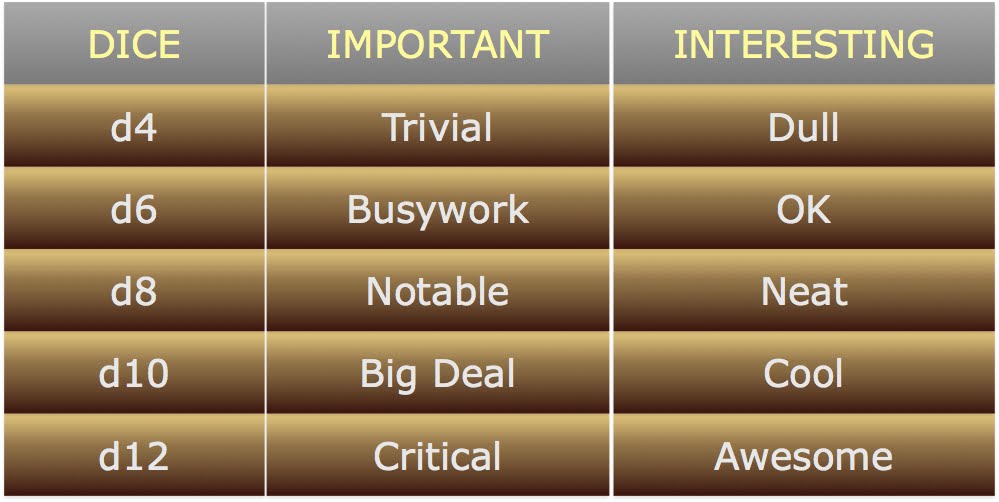
This is one of the smart things about Leverage's distinctions. For the unfamiliar, they either grant a d8 bonus or a d4 penalty and grant a plot point, which is structurally aspect-like. The big difference is that it is totally up to the player whether something helps or hurts. The GM might quibble about whether it applies (usually resolved by the player incorporating it into his narration more fully) but the player is choosing to take the penalty himself.

This is hard to map directly onto 4e as there's no good standard model for penalties, but it's still useful as an illustration - things that players might be uncomfortable with the GM imposing on them, they are often more than willing to do themselves if you give them the chance. To this end, it's not unreasonable to put out _offers_ of plot points in return for bad or dramatic choices, nor is it unreasonable to reward players with PP when they do awesome things, but they will balk if you start telling them what they MUST do.

That said, some players still aren't happy with the GM having his power, and one other option is to move the reward mechanism to the table at large. The most common model of this is "Fan Mail" (from Primetime Adventures) , where players give points to each other when they do awesome things. Generally, this requires some sort of method to keep the points straight, such as giving each player a budget, or putting a common bowl in the center and letting people pay out of that. That may sound simple on the surface of it, but since we're assuming worst case here, you want to have some reason why players wouldn't just optimally distribute points to each other (even though that's pretty lame). One option, for example, is to have them grant them out of a common bowl, which the GM replenishes occasionally, with replenishment based on how many points remain, or how the points were distributed. In this case, you're trying to incentivise using the points as intended, but if your players REALLY won't, then you're better off falling back on a simple reward model.

Alternately, you could use the trick that Swashbucklers of the Seven Skies uses. Players start the game with a small number of points, which they can use for bonuses, or they can give to other players when the other player does something awesome. If the GM agrees it was awesome (which he usually does) then the GM can match that gifted point with one of his own. That is the only way new point get added to the economy, so it creates a curious situation where generosity is the best way to reward the group.

Anyway, my general advice would be this: Get players used to the idea of d6 action points as rewards before you do anything weird with them. Give them out as reward for skill challenges or cool scenes. Get the idea that they're rewards into people's heads. Once you've done that, start being more explicit about what they're rewards for. Tie them to specific things, like milestones or quests, but also give them out when a player makes the table laugh, or does something awesome. If they get comfortable with this, then things like fanmail or specific incentives using action points as rewards will not be much of a stretch. If they stay uncomfortable with this, then you know it's not for your group. If they call it metagaming, then they need to spend less time on the Internet.

But the bottom line is that introducing in-game rewards (mechanical bonuses) for roleplay is, for many players, a non-intuitive leap. They're different things, and the difference can be jarring. Far better to ease them into it and see if it works than it is to just throw them into the deep end and hope they swim.

Friday, April 15, 2011

What Not to Write

Thinking about other characters and how they can drive play lead me back to a thought that lives in the same orbit as the thinking in my Getting Villainy Done post. The hang up I’ve been running into is this: games are full of things that are _interesting_, but just because something is interesting as a fact does not automatically make it interesting to *play*.

If you look at a random setting, it is probably chock full of color, and much of it will be compelling and, as a reader, really help you bring things to life. Griffon-riding mailmen! Elemental Zeppelins! Randian Cults! Whatever they may be, most of this information will be presented in a way that makes an interesting read, but very rarely in a way that directly suggests _play_.

This is, I think, by and large unintentional, or perhaps to put it another way, well-intentioned. The idea is that if the written material is reasonably comprehensive, then the GM is capable of extrapolating interesting adventure hooks from it. Cynically, this also allows for material to cater to more tastes, as a certain category of buyers doesn’t want adventure hooks, since those go outside the bounds of “How the world works”, which is what really drives their need.

The problem with this approach is simply that it allows for unhelpful writing. I won’t call it lazy, because I know it’s not - these writers bust hump to make things interesting and fun to read. But if the author doesn’t need to think about how the setting material’s going to be used, then she may not, and the net result is really interesting color that does little to nothing to drive play.

This problem becomes more profound when you start talking about lateral play. Players who write back stories have even less interest in playable information than setting designers. They often have deep piles of self-reflective information or arbitrary (and usually lame) SEKRITS that they absolutely won’t tell any other player about.

That’s not a terrible problem in its own right. Lord knows that’s how it’s always been. But this becomes a more pressing issue when you start thinking in terms of what playable information characters are going to have in their background. That is to say, players are well served by mastering playable information too, if only to help come up with character backgrounds that will actually engage other players, rather than be just another failed special snowflake.

Thursday, April 14, 2011

Lateral Connections

One thing that has really been sticking with me about Dragon Age 2 has been (as is so often the case with Bioware titles) the relationships and personalities of your companions. Certainly, the arc of your hero is interesting, but it is the people around you that make it feel personal and compelling. DA2 does well enough in this that a few of your companions feel like they could be heroes (well, protagonists) of their own stories, yet this does not diminish your story in the least. Of course, the conceit that your story is being told by one of them does not hurt this perception.

Translating this to the tabletop is an interesting challenge for unexpected reasons. Certainly, there are lots of ways for a GM to make NPCs more compelling, and I’m all for those, but I don’t think they apply. It is far more apt to consider the other characters to be comparable to the other characters played by your fellow players.

Through that lens, the challenge is obvious: How can you create and encourage that kind of lateral play?

For all the reams of advice about players dealing with GMs and GMs dealing with players, there’s precious little about how to drive play between players. I suspect a lot of that is a result of game books being primarily written for GMs, and thus assuming the GM-Player dynamic out of habit. A few games address this, at least indirectly. One of the most subtle and brilliant rules in The Shadow of Yesterday is that you refresh your pools with certain types of actions, but those actions MUST be social in nature. Since everyone has the same pools, there’s a mechanical incentive to go do player-initiated stuff together.

Smallville deserves mention in this regard because I cannot think of another game where lateral connections are so essential. Relationships with other characters are an essential part of your character sheet. This is mighty stuff, but in some ways its _more_ of a solution than I’m looking for. I don’t want things to be quite that explicit, but at the same time I want character issues to be drivers of play with each other, at least occasionally.

Specifically, I love the idea that character A's issue creates play for Character B (and perhaps the whole group) rather than just being something that Character A deals with. Maybe this demands that issues come with an explicit "and here's the reason I can't deal with it myself". That's a good start, but I might go even further and find a way for character B to pursue the issue because it indirectly creates a problem for character A, if only because character B is distracted. Hard to do persuasively, though.

I am not entirely sure if this is possible, but it’s a problem I’m chewing on right now, and if nothing else, it’s producing some interesting flavors.

Wednesday, April 6, 2011

Getting Villainy Done


So, I'm a (slightly lax) practitioner of David Allen's Getting Things Done (GTD) methodology, which is a fancy way to say that I use a certain set of tricks for keeping useful to do lists. GTD has been incredibly useful for me in a number of ways. I've mentioned before how well it applies to player actions, and recently I've been thinking about how one lesson in particular translates very well into adventure design.

See, the trick I learned from GTD, and which is good all around advice, is that when you put an item on your todo list, it should be a physical action, not just an idea. Too often, people write down something general like "Set up New Desk" and it sits idle because they haven't thought about the actual actions they need to take, which might be "Clear off the current desk, haul away current desk, bring new desk to office, bring tools to office, assemble new desk". Each of those actions is something that can be envisioned, accomplished and checked off, and if you have a concrete list like that, you're much more likely to actually do something rather than put it off.

As useful as this idea is for getting chores done, it's even more useful for villainy. Just as physical actions can bridge the gap between needing to do something and actually doing it, they can bridge the gap between a villains abstract goals and motives and actual play. Which is to say, take a few minutes to look at your villain's (or other prominent NPC's) to do list. After all, every good NPC has some sort of goal they need to accomplish, and that should always demand some sort of action.

For example, let's say we have a small crime boss in the city of our game. We'll call him Mart, and he's looking to expand his holdings. That's a great one sentence blurb, comparable to what you'd see in a published product, and it makes a good seed. To create some play from it, let's drill down a little bit. He can't get up in the morning and just expand his holdings - he needs to do things to do so - so what can he do? Well, he'll need more men, more territory, or more business. So let's make that his todo list:
  • Get more men
  • Get more territory
  • Get more business
So, we've gone from a goal to a broad list (in GTD terms, these would be projects) , but now we need to break it down into actions, and in doing so, we'll see these are more complicated than it seems. Again, let's pick one: Getting more men.

Getting more men is not just a function of putting up flyers for thugs. Men need to come from somewhere, and they need a reason to work for him. He needs to find a source of men and get the resources to bring them on board. Now, if this were a real-life project, we'd have steps for gathering information and analyzing options, but in fiction, we can skip that (I say this casually, but it's a very powerful and creative capability). Let's say, for example, Mart sees three opportunities. First, recent bad weather has left a lot of out-of-work sailors. Second, it's always good to recruit early from neighborhood kids. Last, there are always mercenaries available in a pinch. Mercenaries are easy, and kids are complicated, so let's use the sailors to illustrate further.

The sailors are a good starting point, but he can't just walk into a bar and ask the room "Any out of work sailors want to do some crime?" I mean, he could, but it's not a good strategy. He could put up a posting, which might get some (if they can read) but it might get too many, too few, or unpredictable quality. Plus, it is fairly public, which may be problematic. A better plan might be to make contact with a reliable agent and use them as a go between to bring on the sailors to…what?

Here we hit the rub, and the benefit of the system. He's not just hiring sailors to hire sailors. He's hiring them for a purpose, to expand his holdings. He needs a plan of action for them. So, these are sailors, not necessarily reliable, but available. Maybe he gives them a little extra coin for drink to go to a bar outside his territory he want s to annex and be on hand when he sets up a dice game and basically lays claim. That's a plan. So, his task list looks like:
  • Speak to bartender in the docks to identify a smart, hireable sailors.
  • Interview said sailor.
  • Offer him employment.
  • Get said sailor to spread around drinking money with strings attached.
  • After sailors gather, start dice game.
  • When confronted, escalate to violence.
  • In conflict, overwhelm opposition with superior reinforcements (sailors).

All very tidy, but the trick of it is that each of those steps is concrete enough that it can either be a hook or a problem. A specific action might impact players (forcing reaction) or it might go wrong (forcing the NPC to improvise and call in help, which is to say, the PCs) . Finding the hooks is a simple matter of running through the list and asking
  1. How might this impact PCs if this happens to them or someone they know?
  2. What happens if the PCs find out about it?
  3. How can this go wrong?

Looking over that list and Mart's list, my two guy with swords might
  • Overhear the conversation, find out about the plan, and...
    ...realize a fight would be a great time to rob the dice game.
    ...realize they could make money selling out this plan to the competitor
    ...beat up the trustworthy sailor and take the money
  • Get approached by Mart after the trustworthy sailor runs off with the money
  • Get brought in by the tavern owner, afraid someone's going to muscle in on his territory
  • Get drawn into the fight as it breaks out around or near them

And that's just off the top of my head.

Anyway, what's important is that all of this built from a sentence: Mart is a criminal who wants to expand his holdings. Published material is full of similar information, but it often lacks guidelines for moving from those motives into things that generate play (unless the motives directly apply to the PCs to begin with). Going to specific actions is a great tool for bridging that gap, and it's a fun one. Remember, there's no need to do this with EVERY element in a game. Doing so would be way too much to keep track of. Instead, it's just a tool to go from "huh, I'd like to use this NPC" to "I have a plot involving this NPC" in a very natural feeling way.


One other thing: I realize that for some people, thinking about NPCs in this fashion gives them too much agency. Some feel that NPCs should only have an existence in the context of the PCs, and that this sort of thinking is inappropriate. To that, I suggest that this idea is not contradictory to that, it is merely tangential to it. The ultimate purpose here is to inspire intersections with your players that feel dynamic and like they're a natural extension of play. Whether or not this exercise produces any "offscreen" impact is totally a matter of GM taste.

Tuesday, April 5, 2011

The Challenge is Challenge

I used to run out of inventory space on my D&D character sheets. I was utterly fascinated with packing just the right tool for every sort of situation, and I spent an unreasonable amount of time figuring out the lightest, most useful kit I could pack. As a player, it's a lot of fun to come into a situation and have just the right tool to short-circuit the challenge and move on (especially because the challenge is almost certainly unfair in a substantial and gygaxian way). There's sort of a double satisfaction to this because, outside of fiction, it's what good problem solving looks like: finding the easiest, most effective solution with the tools on hand.

Unfortunately, that can make for a very boring game (and a frustrated GM).

A lot of adventure design gets committed to keeping things from being simple. The logic behind this is reasonable enough: simple challenges are quickly resolved with little sense of risk or engagement, and that is a recipe for boring play. Unfortunately, the obvious solution (making things arbitrarily more challenging) is workable but ultimately counterproductive.

To illustrate this, consider a dungeon. There might be some reason to go into the dungeon (rescue the hostage, let's say), but how many of the challenges you're going to run into have any bearing on that? In some adventures, they might all be, but I think we all have experience with the adventure where there's a mandatory quota of fight scenes with random-seeming monsters. Those encounters "flesh out" the adventure and keep it from being too simple.

But that's sloppy design. It's LAZY. Look at it this way: if I have a bunch of cultists take a prisoner, there are lots of ways I can make the adventure more challenging. I can include an important NPC among the cultists backers, meaning I may face legal barriers keeping me from pursuing the cultists. I may face hard choices in terms of the price of stopping them. Maybe the cultists are not so morally black as I think, calling into question the righteousness of violence as a solution. I can introduce a second challenge (Burn Notice Style) and make the real difficulty in juggling both concerns.

Or I can just add a few more monsters/fight scenes.

Now, don't get me wrong. I love good fight scenes. If I want to add more of them, there are plenty of ways to do it that make more sense then "And behind this door lives a shambling mound!" Similarly, I'm sympathetic that for any published adventure, the lack of hooks into the specifics of the campaign being played limits options, but I must add that it doesn't remove them entirely. There are too many examples of good adventures to pretend it can't be done.

The specific solutions for this are going to depend a lot on your game, but the question it raises is always going to be the same. When looking at a challenge you're going to throw at your players, ask yourself how it's going to make the game better as well as harder. There are lots of good answers, including "It will be an awesomely fun fight", "I need to give this player some spotlight time" or even "Holy god, I need to fill an hour - Fight time!". Just make sure you have an answer.

Monday, March 7, 2011

Fiction, Fairness and 4e

In my discussion of the role of skills in spotlighting character awesomeness in 4e (or more precisely, the lack of this) the counterpoint of solving the problem in the fiction of the game was raised and I think this merited some attention. There are a lot of issues with games – not just 4e but any other games – that can be addressed in the fiction of the game rather than with rule changes. This is especially true of things that relate to the role of the players in the context of the game. How important and respected the characters are is only sometimes a function of rules. However, there’s a point where this breaks down. When you need to solve a problem for the group, then look to the fiction, but when you need to solve a problem for a character, it’s less reliable.

Let’s look at the specific case of rangers and tracking. If I want to respect the idea of tracing as a Ranger schtick despite 4e’s not doing so, there are a few fiction and technique options available to me. I can certainly have other people _react_ like he’s exceptional (fiction) and I can make his failures more reflective of his awesomeness (You didn’t fail because you sucked, you failed because it was SO HARD that only you even faintly had a chance of doing it! - fiction) but that’s a pretty meh solution. The reactions aren’t very compelling unless they hold water in play. The fiction of failure looks like a good idea on the surface of it, but it leads me to ask when you’re _not_ doing that? If respectful failures are only an exception in your game then I would consider that a red flag.

The last solution is, of course, to make the Ranger’s rolls inherently more potent, or increase the number of situations where I don’t call for a roll. I can certainly couch this in terms of fiction, but the reality is that at that point I’m making a mechanical distinction (whether I acknowledge it or not) and that’s where the ice gets thin. At that point, we have to deal with the reality that someone else in the party can make the roll too, and they (reasonably) expect that the outcomes of their rolls will be proportional. If the Ranger and I both roll a 17 but his outcome is much better than mine, I’m going to call foul.

Now here’s the important point about it being a rule that’s very easy to overlook. My objection is not going to be that Ranger’s shouldn’t be awesome at tracking. If you ask me, I’ll agree they probably should be. Rather, the root of my objection is that this idea has never been communicated clearly or usefully, and my expectations have been violated. I like to assume that most GMs are good enough to make smart, engaging, fun rulings on the fly, and that’s great, but it’s foolish to rely on that. Not because the GM is going to trip up or be a jerk, but because the players have no visibility into a ruling-based process. A rule is a means of communication, and in solving problems (especially problems between players) more communication is almost always better.

Now, obviously, some games call for more or less of this (The Amber DRPG is almost entirely ruling based, while 4e actively strives to minimize the need for such rulings) and more, some tables have radically different ideas regarding how this should be approached. Often, the “GM-As-God” approach has less to do with GM authority than with lack of GM accountability. And if people dig that, then awesome. Go forth and continue having fun.

But the bottom line is this: the fact that the GM can fix things in play does not excuse shoddy game design, and it doesn’t excuse shoddy GMing either.

Friday, February 25, 2011

Investment in Advancement

Haven't done a random idea post in a while, so I figure I'm due.

Twitter discussion with @atminn gave me an interesting idea for how to handle player investment in the setting in a way that ties it directly into advancement. I'm going to present this in a fairly generic fashion, but the concept is pretty easily portable to whatever system you prefer to use.

The core idea is a basic one - tying character advancement to the investment in the setting by tying points earned to specific setting elements (usually people) and paying out advancement when those elements how up in play. The basic model pays out something like this:

1 point if the element shows up during the session.
2 points if the GM has to "take the reins" of the element and actively use it during the session.
3 points if the element is central to the session, seeing use in many scenes.
4 points if the element is put at risk
5 points if the element is lost or destroyed.

This can be tracked pretty easily with something like this on the character sheet - just mark the box as it happens, then pay out the highest value at the end of the session.

For Example, if Lord Chuzzleworth (Chaz to his friends) is your anchor, you might get the highest of the following in a given adventure:
  • Get 1 point if you say go see him, send him a letter or otherwise bring him up in play (it's very easy for a player to get 1 point).
  • Get 2 points if the GM uses Chaz to hire the group to do something.
  • Get 3 points if that something is to escort Chaz to Castle Winterscap
  • Get 4 points if there are assassins after Chaz specifically (as opposed to generic road dangers)
  • Get 5 points if Chaz gets killed.

Now, by itself this is pretty abusable, since it basically encourages players to get their elements killed and replaced as quickly as possible, so there needs to be some check on that, allowing for investment in an NPC or other element to grow over time. To model this, I propose that at the end of every session (and chargen) the player gets a point. That point can be used to add a new element at "rank 1" (more on that in a second) or to increase the rank of a current element (I'd cap the maximum number of elements somewhere around 3).

The "rank" of an element indicates it's maximum payout. That is, if your character's father is one of his elements, but only at rank 1, then the character only gets 1 point of XP when dad shows up, not matter how involved his role. This is not exactly speedy investment, but it makes the ideas of risk and loss carry a bit of a mechanical edge in addition to whatever they may mean in the fiction.

There's a lot of implicit information for the GM to work with in this kind of setup, but most importantly, it can turn the player into an advocate for risk. Even the most mechanically-minded player has incentive to push things towards the more dangerous (and interesting) outcomes, and at the same time offers some small payback if things go horribly wrong. In some ways, it's the flipside of the XP system from The Shadow of Yesterday. It's not player directed, as TSOY is, but that sentiment of transparency and explicit xp hooks is definitely baked into the thinking.

Thursday, February 24, 2011

The Princess Is In Another Castle

A couple of people asked in comments yesterday what I mean by unfairness. I started to reply, but it ran long enough to turn into today's post. Now, while it would be easy to turn to fiction for examples, the simple truth is that most any good example of unfair from fiction would be a spoiler, so I must tread carefully.

At its heart, unfairness hinges on expectations, in this case player expectations. They did X, so they deserve Y. They Killed the dragon so they deserve the reward. They broke into the vault, so they deserve the treasure. When they don't get it, it's easy to be pissed or to feel the GM pulled a bait and switch. The players had a reasonable expectation of outcome (both mechanically and within the fiction) and the GM is explicitly defying that expectation, usually through simple expedience of the GM narrating the world (which someone will insist on calling fiat because, hey, what's a good discussion without fighting words?)

A very bad example of unfairness would be the player's rescuing the king from assassins, but he then dies falling down the stairs. That's kind of random and capricious, and it makes a useful example because of the reasons it doesn't work. It definitely violates the player's expectations of outcome (they saved the king, he should damn well stay saved), so why is it a bad example? It's because the reversal is too neutral. It's bad, sure, but it's not BAD. In contrast, consider the example of the heroes saving the king only to have him believe that THEY were the assassins, and call for their heads. That's unfair, but it's the right kind of unfair.

Good unfairness can be found throughout darker fiction (Martin, Morgan and Abercrombie spring to mind). Heroes are reviled and villains exalted. No good deed goes unpunished. You know the drill.

Dramatically speaking, it's all about the emotional charge. Mckee and Snyder both talk about this, but I'll sum up: in fiction, a good scene starts at one emotional state (positive or negative, + or -) and changes state over the course of the scene (or beat, depending). Sometimes those go to double positive (++) or double negative (--) for great victory or terribly defeat, but the general idea is pretty easy to grasp. In almost every interestingly unfair situation, the players are expecting a big payout (++) and the GM instead hands them a ticking time bomb (--). That's a huge emotional jump, going from the high of the expectation to the abrupt low. This is why the king falling down the stairs is kind of lame. It's bad (maybe - at worse) but it's got no real punch for the players. The emotional level doesn't make as big a jump, so it's just kind of annoying.

But here's the rub - the power of the event is all about that unexpected reversal. The bigger the gap, the more powerful the moment, and that's what demands unfairness. Specifically, it must be unexpected, and under any kind of measure of fairness, that big a jump would simply not be possible. It requires disempowerment, opacity and surprise, all of which are INSANELY abusable things. But they do the job.

Now, I want to note that unfairness is not necessary for the _events_ to occur. A fair table populated by players with a good sense of drama are fully capable of inviting outcomes on themselves every bit as brutal as the dramatically unfair GM is going to do, perhaps even moreso. But I am saying that unfairness (or more aptly, the surprise and dramatic shift which only unfairness can allow) is the only way to deliver the real gut punch.

Obviously, this is only one sort of payout. I don't expect every table to prioritize it the way that I do, nor would I want them to. Games offer a huge array of emotional rewards, and it's well worth going towards those you value most. But it's an important one for me, and I consider it a tricky one to do well, so I figure it was worth some air time.

Tuesday, January 11, 2011

Pacing

The first post-holiday game of the Cold War game I've been running was last night. Coming back from a break is always rough, and there's often a fear the game will have lost it's inertia during the hiatus. Thankfully, things went off very well, and we had a great adventure chasing shadows and lightning in time-stopped Washington DC.

It was a great session, but I was not originally going to write about it. We'd had fun, but I'd had no particular mechanical insights as a result of it, and I'm not comfortable saying how awesome a session was without some sort of excuse. I have a skill challenge idea queued up that's chomping at the bit to see daylight and I was ready to let the session go by with a nod until Fred noticed something: we had finished early.

This is strange enough that we went back through the usual range of possible explanations: had we started early? No, we actually started about 15 minutes late. Had the session felt skimpy on content? Nope, it had been pretty much stuffed from end to end.

We had no explanation, except that the pacing of this particular adventure had really just rocketed along. I was a bit surprised myself, since I hadn't exactly planned for it to be a fast session, but in retrospect I saw many of the decisions that lead to it. Some of them were just good habits, but some of it seems to have been an upshot of running Leverage (and its variants) over the break. Leverage does a lot to support very tight pacing without calling it out explicitly, and I need to keep a few of those things in mind. Some of them are classics (like starting out with a bang) but a few more are up for consideration of a permanent place in the toolbox. Notably:

Niche Protection is Not Just For GMs - It helps things a lot when players have an understanding and respect for the strengths of other characters, measured by the simple rubric that if they encounter a problem of a certain kind, are they more likely to just try to tackle it or are they likely to call in the expert? This has a subtle impact on how effectively you can play with a divided group: if the group has that level of respect, then getting divided isn't a big deal because they'll naturally draw each other back into play. If they're all rugged individualists or roughly equally capable, then things can remain unfocused. Mechanics play a role in this (as you often want the guy with the bigger bonus) but it really hinges on the players buying into the idea to work.

Small Details Carry Weight - In Leverage, these tend to take the form of post-its littering the table in front of me, which demands a certain brevity, but I came at it from a different angle last night. To underscore the oddness of the time stop, I made the decision to switch to the language of a horror game in my descriptions. That meant small, colorful details but not a lot of dwelling on minutiae. Draw attention to things that change. The net result may not have been hugely scary, but it was surprisingly focused. Horror, after all, depends a lot on pacing to maintain tension, so it's no shock that what works for it can work well for other pacing.

This kind of terseness also goes a long way towards helping your players create strong visuals in play (since it gives them more freedom to play while providing simple building blocks to anchor from). Since those are the things they're going to take home with them at the end, don't underestimate how big a deal that is.

Maintain a Clear Course of Action - This is one that's going to be easy to say, but maybe hard to explain, and I expect to chew on how to express it more effectively for a while, but the short of it is this: the clearer the course of action is (clear in terms of evident, not necessarily clear in terms of a lack of obstacles - obstacles are half the fun), the faster things will move, especially if there is some external pressure to keep things moving. On its face, this is dangerously close to a case for railroading, but that's not the heart of it at all. For one thing, there will often be more than one useful course of action, and for another this is about action on the scene level, not the whole arc of the adventure.

This hinges on information management - it's all about making sure the players have enough information to make decisions (at least most of the time) and that means that they need to feel confident in their knowledge of 1) What they would need to do, 2) Whether or not they're capable of it and 3) the immediate consequences of doing so. Adversarial dungeoning encourages GMs to be be very cagey about these data points, especially #2 and #3, but that's a bad instinct. Not only does it slow play, but keeping everything obscure utterly devalues the things you shroud for good reasons.

The Good Parts Version - This is an old one from the bottom of the bag that merits dusting off. The speed of a particular scene or action should not depend on its importance, but rather it should be inverse to the level of player engagement. The only long scenes are ones where all the players are engaging each other - everything else deserves to be brisk and keep the ball moving. If it's something a player enjoys, it should take longer than something that's clearly a plot necessity.

This technique is super-useful to GMs looking to weed their own garden. It makes you aware of things you're stretching out because they're cool to you but not your players, so you can decide what to do about that.


Anyway, it's not a science yet, but I feel like I may have started getting my hands around really making pacing work. Which is one more reason I need to get working on that Skill Challenge thing.

Monday, December 13, 2010

Leverage Magic; What Not To Do

As noted, I've been thinking about ways to add magic to the Leverage system. It's actually quite easy, especially if you're going to be adding it from scratch. It's a bit rougher when you are trying to emulate a specific magic system, but that's always the way of it.

This has lead to a bit of mechanical experimentation, and one particular bit of sausage-making struck me as something useful to talk about. There's a particular approach to fiddling around with Cortex Plus that is intellectually very appealing, but which produces the kind of results that look cool on paper, but end up leaden at the table.

Consider, if you would, Button Men. For the unfamiliar, button men is a simple dice fighting game from Cheapass games. The basic mechanics are very simple and easily adaptable to many situations (I've run entire wargames using them), and at their heart they boil down to "Each side rolls a bunch of dice. On your turn, you can remove another players dice if one of yours shows a higher value, or if you can add up dice to equal a value they show. After a 'capture', reroll any dice involved in the capture" Dice are scored based on their size, so you run the gamut from d4 to d30, and you can really throw down with almost any 5 dice. As time went on, special dice were introduced into the mix, with extra rules, and that's where things get curious.

Button Men is interestingly informative for Cortex Plus design because the dice tricks it includes are designed for a range of die values rolling against a competing pool. It seems very natural to bring those ideas over into a Cortex Plus roll by introducing ideas like "Knock a die out of the opposing pool", "Force an opponent to reroll a die" or "Reroll one of your dice". You can build some pretty cool stuff with this, stuff that allows for some sophisticated interplay between opposing rolls.

But whatever you do, don't.

This is one of those cases where the fact that you can do something doesn't mean you should. At present, resolving Cortex rolls is pretty quick - determining success is very fast, and spotting any complications or opportunities is only slightly slower. There may be some delay _before_ the roll, as decisions get made regarding what dice get brought in, but by and large that is a fun kind of delay because, to sound a little wonky, players are usually engaging the fiction (which is in turn represented by dice). The inertia of play keeps moving (or can keep moving - it's possible to bog down if people get too bonus-obsessed, but Leverage doesn't particularly reward that).

In contrast, playing dice games after the roll is a total show stopper. Yes, some players can glance at the dice and near-instantly make all the decisions necessary to move forward, but they are very much the exception. Play is more likely to stop as players consider the smartest option. This speaks directly to Linneaus's first principle of dice game design: Downtime is the enemy. No one want sot be left sitting there at the table while a player decides which of two options is marginally superior.

In broad game terms, this is something you avoid by making choices simple or obvious. This seems counter-intuitive, at least in part because we don't want to neuter the player's choices, so let me unpack this a bit. When we're talking pure game decisions, we want to minimize uncertainty. To use 4e as an example, players have a lot of tactical choices, but the only real uncertainty is whether they'll hit or not, and that applies equally to all options. A player may need to make a decision between burning a daily or encounter power in a given attack, and while this may lead to some indecision, that indecision is not rooted the player not understanding the outcome.

In contrast, let's imagine a Leverage rule that let's you force a reroll in an opposing die. If that die came up showing it's max, then it's no real choice, but what if it just rolled ok? What if forcing this reroll means you also reroll one of your dice? On a close roll (especially if there is other uncertainty, such as what tricks the GM might pull[1]) you can utterly freeze up.

Anyway, the bottom line here is that it is possible to introduce all sorts of dice tricks into Cortex Plus, specifically Leverage, but it's not a good match.


1 - This, right here, is one reason I prefer GM transparency. When the GM has mystery powers to throw into the mix in response to player actions, it invites paralysis and paranoia.

Wednesday, December 8, 2010

But the Crack Came Back...

So, Cataclysm dropped yesterday. For those unaware, this is the latest expansion for World of Warcraft, and it has successfully drawn me back in. I lost interest a little while after the last expansion (Wrath of the Lich King) and turned my account off for a while, but I turned it back on just before Thanksgiving in anticipation of Cataclysm.

In fairness, most of what I wanted out of the game came in the pre-release patch they issued in November that updated the world and introduced everything but the new content (The ability to level up to 85, opening new zones and so on). That may not seem like much, but it was actually quite huge. Basically, they rewrote the whole setting from the ground up.

In game, they have effectively moved the clock forward. How much is a bit of a question, as I have so far seen indications of it being anything from five to twelve years, but the net result is that the world has changed in ways that are _intensely_ satisfying to someone who paid attention to the lore. Important NPCs have died, boundaries have shifted, and as a result of the eponymous cataclysm, geography has been drastically altered in places.

At the same time, Blizzard has taken the opportunity to fix...well...everything. Virtually every zone has been scrubbed and rebuilt according to the lessons they've learned from running the game for six years. They've made travel easier, clustered quests more intelligently and removed a lot of the busywork of play without removing all of it. That last is perhaps the most brilliant of them - some busywork is necessary to help maintain the addictive nature of play, but striking just the right balance with it is essential. As an example, I will point to mining.

In play, there are little nodes of metal deposits scattered throughout the world. If your character is a miner, you can click on one of these and, after a few seconds of animation, you'll get some metal. Originally, you did this once, got one piece of metal, and the node disappeared. The result was that metal was fairly scarce, and at some point Blizzard patched it so you could do this several times per node (usually 3) before it disappeared. This was better, but you had to do the click and wait 3 times. Now, you click and wait, and you get several pieces of metal - the same reward as doing it several times, but without the extended wait. It's a small fix to a small minigame element, but it's the kind of attention to detail that makes a game work.

Even if you never play WoW, there are lesson in Cataclysm that you can probably take back to your game. To my mind, the big three are:

Make Fun Easier With the Right Kind of Challenge - Cataclysm does this by restructuring quests by putting the guy who gives you a quest much closer to where you need to do the quest. Similarly, the game makes it easy for you to find where you need to go to do it. Now, this is not to say that you should start saying that your game should start collecting 10 wolf ears to give to Hornswaggle Beltbuckle, but you should look at the structure of it. Challenges which are difficult, but which have a clear course of action are FAR more satisfying than challenges which are frustrating because the course of action is unclear.

For example, if you are given a quest to kill goblins until you find 10 goblin beads, then bring those back, there are two ways you might be stymied (beyond the goblins' objections): The goblins aren't dropping[1] the beads fast enough, or you can't find the goblins. In the first case, you might be annoyed, but you know what to do: just keep killing goblins. In the second case, you will quickly end up frustrated, maybe check an offline resource or otherwise completely break your flow (there's an even worse version of this where you're killing the _wrong_ goblins, but that's a whole other thing). WoW has minimized the likelihood of this second kind of problem, which means that most problems that remains are ones you address by playing the game. Presuming the game is fun, that's as it should be.


Immediate Feedback is Powerful - Feedback is a curious two-way street in MMOs, because it applies to both play and design. Blizzard mines data on play like mad so that they can judge the impact of changes they make, and while GMs might take a general lesson from this (pay attention!) we tend to lack the tools and sample set to apply that sort of rigor to our games. However, we can take a lesson from how WoW handles feedback to the players.

Characters in WoW level as you would normally expect in an RPG, but they also are progressing in dozens of other ways at the same time, between their faction with other groups, their profession skills and the assorted accomplishments and awards one can get throughout the game (such as for exploring a zone completely). Because there are so many of these in play, if you don't pay attention to them, then the rewards they give when you achieve something come as pleasant, semi-random surprises that occour with fair frequency (more often early in play than later). That's powerful by itself because it hits the same part of the brain that wants to give slot machines money. But what makes it more subtly potent is that if you _do_ pay attention to one or more of these, there are concrete actions you can take which will improve the one you pay attention to. It can take work and time, but the ability to generate immediate, measurable improvement triggers a feedback cycle that does not limit itself to paying out once per session or once per level, but rather, rewards the activity. So given that, how often does your game give rewards?

A Changed World is a Richer World - Bumping the timeline forward is incredibly rewarding both to players (who can appreciate the changes) and to GMs (who benefit from re-purposing old materials), and even if not done as a dramatic jump, it is incredibly cool to come back to the town outside the dungeon you cleaned out a few years back and see how its changed (for better or worse), especially when those changes tie directly back to the PCs an their actions. If you look at a lot of published adventures, they often depend on the backstories of the people involved which do not touch up on the PCs at all. Being able to make the PCs part of that backstory? Priceless.

As a bonus, this is a great way to take ownership of a published setting. Even if you started in Eberron as published, Eberron five years later is much more clearly YOUR Eberron. It's perhaps not as dramatic a statement as killing Elminster, but it is more widespread.


Anyway, enough of that. I have goblins to kill.


1 - For the MMO ignorant, "drops" are loot. You kill something, loot the body, and find what it's carrying, usually some coins and junk. If it has a bead, it is said to have dropped the bead.

Tuesday, December 7, 2010

Cinematic Difficulty in Cortex

Not every Cortex game uses opposed rolls, instead relying on difficulties for handling some simple situations. Leverage does not, but that is in large part because Leverage's mechanics depend on some very specific interplay among the dice. It's easy to see why some games would do this: it's certainly less work to call for a roll and just see what it hits difficulty wise. It allows for a little bit more predictability: the GMs 2d4 has that oddball chance of coming up 8, while a simple difficulty does not. That means the GM has to deal with fewer situations where the dice take things in a direction other than what's expected.

Those are all good reasons to go with difficulties, but turn them a few degrees and I find them a persuasive argument for using opposed rolls all the time. Why? Because the opposed roll forces the GM to think about the roll, enough to ask herself "Is this really worth rolling for? Am I really ready for this to be interesting, however it turns out?". That little bit of extra thought can make all the difference between keeping a game cracking along and getting hung up on some stupid roll going wrong. Obviously, rolls will go wrong with opposed rolls too, but the GM should be more prepared for that outcome.

That said, setting difficulties in Cortex is not always intuitive. If the GM has a whole lot of attributes out on the table, then she can usually build a roll out of them, but that's not a reliable resource. Sometimes the material's just not there, sometimes your players go off in another direction entirely, and none of the material you have on hand are of any use.

In the absence of that, I suggest some guidelines for creating difficulty based on two words that you can assume almost everything has: "Normal d6" and "Thing d6." That is to say, if you need to roll for the security guard in a complete absence of other information, then he's a Normal Thing (or Guy, in this case), so 2d6. Easy peasy. Structurally, this is an extension of the basic rule that you fill in empty slots with d6s, but conceptually the difference is all about making sure there is language to these things.[1]

Assuming one-off rolls, this is not always going to make sense. Sometimes roll should be pretty trivial, but you're willing to call it to fish for complications. Sometimes a roll will simply be harder solely because the player is making it harder (such as, for example, trying to con someone in a language he speaks badly rather than his native tongue). For those situations, I suggest that a cinematic model of difficulty can be applied.

A cinematic model of difficulty hinges on two axes: is the task important, and is it interesting? These are possibly counterintuitive to someone who is used to thinking purely in terms of whether the task is difficulty or not, and if this is too weird for you to think about, consider that interesting and difficulty usually go hand in hand, and I'll treat them as a pair in my examples.

Important, however, is the rub. If we were shooting the movie of this game, how important is this task? Is it a trivial distraction, like distracting a barrista to get a free scone? Or is it something critical and high stakes, like disarming the bomb before the timer reaches zero? Important tasks are, by their nature, high tension and high risk, and the size of the importance die reflects that. Identical tasks can have different importance depending on the context - picking a lock may be only moderately important in a bus terminal, but it's much more important when the water is rising and the sharks have just been released.

Interesting also ties into the movie of the game: how cool would this scene be to see? How exciting is it? How awesome will it look if the character pulls it off? Hard things tend to be more interesting, at least so long as they're visible to the viewer: one math problem is probably about as interesting to the viewers as another, which is to say, not terribly.

The net result of embracing these two axes is that the cooler the roll is, the harder it will be. Think about that for a moment - the greatest reward will be the most difficult to achieve. There is a specific, rewarding symmetry to that, and let me call out right now that it is not to everyone's tastes, but it's surprisingly adaptable. For example, many players take great satisfaction in reducing difficulties through careful planning, seeking to maximize their chances of success. At first blush, such players might seem at odds with this approach, but consider that these machinations may be seen as turning down the Interesting Dial (as things are now a little less seat-of-the-pants). That player is rewarded with what he wants - less risk, greater certainty.

Which leads to the abuse. Players can, theoretically, game the system by doing boring, unimportant things, and I say, more power to them. Sometimes that's what people want, and if success doesn't change their behavior, then it's good to be able to support it.

Anyway, this is hardly applicable to every game, but on the off chance it tickles your fancy, I use the table below.


(And as a bonus guideline, if you find yourself sitting there with 2d4 in your hand, it may be a cue to ask yourself: Does this even need to be rolled?)

EDIT: Quick clarification for those unfamiliar with Cortex: it is effectively an Xk2 system, which is to say, you roll some number of dice (minimum two) and keep the two highest. In this case, it's assumed those two dice are I&I. In the specific implementation used for Leverage, 1's create problems, so d4s are effectively penalties on a roll: They do not help the total much, and they increase the odds of rolling a 1. Thus, something that's Awesome and Trivial would be d12 + d4, and while that averages decently (at 9, same as 2d8) the odds of a 1 coming up are greater, and creating a problem for the GM. That is to say, GMs looking to not suck out, are well served to make things more interesting and important.

1 - Speaking strictly for Leverage, you should really only do this for truly one-off rolls. If something's going to call for multiple rolls, the Fixer should add a real attribute for them. That said, for other games, you might want to assume the GM has an infinite supply of Normal Things, and only require spending to bump any of those up, or add additional values.