Wrangling Leverage hack ideas has put me smack up against my old nemesis - magic. Magic systems hold endless fascination for me because they are so easy to come up with, but so easy to do poorly. It's not a problem with an easy solution - it's not even a problem with a single solution. There's a reason that Fate core had something like 8 different magic systems, each to capture some specific idea, yet SOTC and the Dresden Files use entirely different systems.
So, let me take, for example, Shadowrun. It's a well known game that makes for a good conceptual match with Leverage. It is mostly a one for one port. Even cyberware is fairly easily wrapped up into the asset rules[1], perhaps requiring a few more signature assets. But magic, well, magic is an oddball. Unlike other settings where we might swap magic into the mix by removing something else (probably hacker), magic layers itself on top of the rest of the game as something else that needs to be added on. Shadowrun magic also has some fairly well-established and concrete rules. Broadly speaking, mages come in two stripes - full mages and adepts, with adepts having some specific subset of magical ability. Within that, there are also other distinctions hermetic vs shamanic traditions, and the oddball case of physical adepts. T here are a lot of rules for how the physics of magic work, though a lot of them are weird fiddly bits that exist to prevent player abuses. The key ones are that magic tires you out (measured as 'drain'), and that summoning stuff is part of what magic can do, but everything else is just fairly vanilla spell lists.
In pulling this over to Leverage, I am willingly shedding a lot of detail. In Shadowrun, there are very important differences between a fire blast and a mana blast, much as there are very important differences between a revolver and an automatic pistol. It's pretty clear to me that the transition will make for a fuzzier system, but the question is always what gets lost and what gets kept. For starters, I'll keep the idea of drain, the basic split (between mages and adepts) and the system idea that you pay for magic by being less good in other key areas.
A lot of this is mechanically easy. Being a mage is this easy: Add a 6th role - Mage (or Shaman). For most people, it's zero. To make your character a mage, distribute your role dice as normal, then reduce them to buy up your mage die. A one step reduction (dropping a die size) in a role increases the mage die by one step (Increasing a size, with the first step being from 0 to d4). Right off the bat, i dig this, because a d4 mage is a magnet for trouble, and does a wonderful job of modeling one of my favorite Shadowrun concepts that never worked mechanically - the burnt out mage.
Adepts work on a similar principle - reduce one of your role dice by a step and add a specialization to the role of your choice, based on the role (only one per character). They're structured a little different than classic adepts, but the underlying principal is the same.
Hitter: Combat Magic or Physical Adept or Bear
Hacker: Technomage or Metamage or Raccoon
Grifter: Enchanter or Coyote
Thief: Illusionist or Physical Adept or Raven
Mastermind: Mind Magic or Summoner or Spider
Mechanically, it's a piece of cake. But now comes the tough part - what are those dice going to do? I can see some rough shapes: Summoning creates assets of the appropriate die size. Complications on magic dice tie to drain or other interesting problems. But that's all fuzzy. I could easily come up with some rule of thumb stuff, especially for adepts, enough to fake it at the table, but that's not a solution. I'll be chewing on this for a bit, and write up what I figure out.
1 - A fiddlier system could be arranged, but tabling that for the moment.
Thursday, December 9, 2010

Wednesday, December 8, 2010
But the Crack Came Back...
So, Cataclysm dropped yesterday. For those unaware, this is the latest expansion for World of Warcraft, and it has successfully drawn me back in. I lost interest a little while after the last expansion (Wrath of the Lich King) and turned my account off for a while, but I turned it back on just before Thanksgiving in anticipation of Cataclysm.
In fairness, most of what I wanted out of the game came in the pre-release patch they issued in November that updated the world and introduced everything but the new content (The ability to level up to 85, opening new zones and so on). That may not seem like much, but it was actually quite huge. Basically, they rewrote the whole setting from the ground up.
In game, they have effectively moved the clock forward. How much is a bit of a question, as I have so far seen indications of it being anything from five to twelve years, but the net result is that the world has changed in ways that are _intensely_ satisfying to someone who paid attention to the lore. Important NPCs have died, boundaries have shifted, and as a result of the eponymous cataclysm, geography has been drastically altered in places.
At the same time, Blizzard has taken the opportunity to fix...well...everything. Virtually every zone has been scrubbed and rebuilt according to the lessons they've learned from running the game for six years. They've made travel easier, clustered quests more intelligently and removed a lot of the busywork of play without removing all of it. That last is perhaps the most brilliant of them - some busywork is necessary to help maintain the addictive nature of play, but striking just the right balance with it is essential. As an example, I will point to mining.
In play, there are little nodes of metal deposits scattered throughout the world. If your character is a miner, you can click on one of these and, after a few seconds of animation, you'll get some metal. Originally, you did this once, got one piece of metal, and the node disappeared. The result was that metal was fairly scarce, and at some point Blizzard patched it so you could do this several times per node (usually 3) before it disappeared. This was better, but you had to do the click and wait 3 times. Now, you click and wait, and you get several pieces of metal - the same reward as doing it several times, but without the extended wait. It's a small fix to a small minigame element, but it's the kind of attention to detail that makes a game work.
Even if you never play WoW, there are lesson in Cataclysm that you can probably take back to your game. To my mind, the big three are:
Make Fun Easier With the Right Kind of Challenge - Cataclysm does this by restructuring quests by putting the guy who gives you a quest much closer to where you need to do the quest. Similarly, the game makes it easy for you to find where you need to go to do it. Now, this is not to say that you should start saying that your game should start collecting 10 wolf ears to give to Hornswaggle Beltbuckle, but you should look at the structure of it. Challenges which are difficult, but which have a clear course of action are FAR more satisfying than challenges which are frustrating because the course of action is unclear.
For example, if you are given a quest to kill goblins until you find 10 goblin beads, then bring those back, there are two ways you might be stymied (beyond the goblins' objections): The goblins aren't dropping[1] the beads fast enough, or you can't find the goblins. In the first case, you might be annoyed, but you know what to do: just keep killing goblins. In the second case, you will quickly end up frustrated, maybe check an offline resource or otherwise completely break your flow (there's an even worse version of this where you're killing the _wrong_ goblins, but that's a whole other thing). WoW has minimized the likelihood of this second kind of problem, which means that most problems that remains are ones you address by playing the game. Presuming the game is fun, that's as it should be.
Immediate Feedback is Powerful - Feedback is a curious two-way street in MMOs, because it applies to both play and design. Blizzard mines data on play like mad so that they can judge the impact of changes they make, and while GMs might take a general lesson from this (pay attention!) we tend to lack the tools and sample set to apply that sort of rigor to our games. However, we can take a lesson from how WoW handles feedback to the players.
Characters in WoW level as you would normally expect in an RPG, but they also are progressing in dozens of other ways at the same time, between their faction with other groups, their profession skills and the assorted accomplishments and awards one can get throughout the game (such as for exploring a zone completely). Because there are so many of these in play, if you don't pay attention to them, then the rewards they give when you achieve something come as pleasant, semi-random surprises that occour with fair frequency (more often early in play than later). That's powerful by itself because it hits the same part of the brain that wants to give slot machines money. But what makes it more subtly potent is that if you _do_ pay attention to one or more of these, there are concrete actions you can take which will improve the one you pay attention to. It can take work and time, but the ability to generate immediate, measurable improvement triggers a feedback cycle that does not limit itself to paying out once per session or once per level, but rather, rewards the activity. So given that, how often does your game give rewards?
A Changed World is a Richer World - Bumping the timeline forward is incredibly rewarding both to players (who can appreciate the changes) and to GMs (who benefit from re-purposing old materials), and even if not done as a dramatic jump, it is incredibly cool to come back to the town outside the dungeon you cleaned out a few years back and see how its changed (for better or worse), especially when those changes tie directly back to the PCs an their actions. If you look at a lot of published adventures, they often depend on the backstories of the people involved which do not touch up on the PCs at all. Being able to make the PCs part of that backstory? Priceless.
As a bonus, this is a great way to take ownership of a published setting. Even if you started in Eberron as published, Eberron five years later is much more clearly YOUR Eberron. It's perhaps not as dramatic a statement as killing Elminster, but it is more widespread.
Anyway, enough of that. I have goblins to kill.
1 - For the MMO ignorant, "drops" are loot. You kill something, loot the body, and find what it's carrying, usually some coins and junk. If it has a bead, it is said to have dropped the bead.
In fairness, most of what I wanted out of the game came in the pre-release patch they issued in November that updated the world and introduced everything but the new content (The ability to level up to 85, opening new zones and so on). That may not seem like much, but it was actually quite huge. Basically, they rewrote the whole setting from the ground up.
In game, they have effectively moved the clock forward. How much is a bit of a question, as I have so far seen indications of it being anything from five to twelve years, but the net result is that the world has changed in ways that are _intensely_ satisfying to someone who paid attention to the lore. Important NPCs have died, boundaries have shifted, and as a result of the eponymous cataclysm, geography has been drastically altered in places.
At the same time, Blizzard has taken the opportunity to fix...well...everything. Virtually every zone has been scrubbed and rebuilt according to the lessons they've learned from running the game for six years. They've made travel easier, clustered quests more intelligently and removed a lot of the busywork of play without removing all of it. That last is perhaps the most brilliant of them - some busywork is necessary to help maintain the addictive nature of play, but striking just the right balance with it is essential. As an example, I will point to mining.
In play, there are little nodes of metal deposits scattered throughout the world. If your character is a miner, you can click on one of these and, after a few seconds of animation, you'll get some metal. Originally, you did this once, got one piece of metal, and the node disappeared. The result was that metal was fairly scarce, and at some point Blizzard patched it so you could do this several times per node (usually 3) before it disappeared. This was better, but you had to do the click and wait 3 times. Now, you click and wait, and you get several pieces of metal - the same reward as doing it several times, but without the extended wait. It's a small fix to a small minigame element, but it's the kind of attention to detail that makes a game work.
Even if you never play WoW, there are lesson in Cataclysm that you can probably take back to your game. To my mind, the big three are:
Make Fun Easier With the Right Kind of Challenge - Cataclysm does this by restructuring quests by putting the guy who gives you a quest much closer to where you need to do the quest. Similarly, the game makes it easy for you to find where you need to go to do it. Now, this is not to say that you should start saying that your game should start collecting 10 wolf ears to give to Hornswaggle Beltbuckle, but you should look at the structure of it. Challenges which are difficult, but which have a clear course of action are FAR more satisfying than challenges which are frustrating because the course of action is unclear.
For example, if you are given a quest to kill goblins until you find 10 goblin beads, then bring those back, there are two ways you might be stymied (beyond the goblins' objections): The goblins aren't dropping[1] the beads fast enough, or you can't find the goblins. In the first case, you might be annoyed, but you know what to do: just keep killing goblins. In the second case, you will quickly end up frustrated, maybe check an offline resource or otherwise completely break your flow (there's an even worse version of this where you're killing the _wrong_ goblins, but that's a whole other thing). WoW has minimized the likelihood of this second kind of problem, which means that most problems that remains are ones you address by playing the game. Presuming the game is fun, that's as it should be.
Immediate Feedback is Powerful - Feedback is a curious two-way street in MMOs, because it applies to both play and design. Blizzard mines data on play like mad so that they can judge the impact of changes they make, and while GMs might take a general lesson from this (pay attention!) we tend to lack the tools and sample set to apply that sort of rigor to our games. However, we can take a lesson from how WoW handles feedback to the players.
Characters in WoW level as you would normally expect in an RPG, but they also are progressing in dozens of other ways at the same time, between their faction with other groups, their profession skills and the assorted accomplishments and awards one can get throughout the game (such as for exploring a zone completely). Because there are so many of these in play, if you don't pay attention to them, then the rewards they give when you achieve something come as pleasant, semi-random surprises that occour with fair frequency (more often early in play than later). That's powerful by itself because it hits the same part of the brain that wants to give slot machines money. But what makes it more subtly potent is that if you _do_ pay attention to one or more of these, there are concrete actions you can take which will improve the one you pay attention to. It can take work and time, but the ability to generate immediate, measurable improvement triggers a feedback cycle that does not limit itself to paying out once per session or once per level, but rather, rewards the activity. So given that, how often does your game give rewards?
A Changed World is a Richer World - Bumping the timeline forward is incredibly rewarding both to players (who can appreciate the changes) and to GMs (who benefit from re-purposing old materials), and even if not done as a dramatic jump, it is incredibly cool to come back to the town outside the dungeon you cleaned out a few years back and see how its changed (for better or worse), especially when those changes tie directly back to the PCs an their actions. If you look at a lot of published adventures, they often depend on the backstories of the people involved which do not touch up on the PCs at all. Being able to make the PCs part of that backstory? Priceless.
As a bonus, this is a great way to take ownership of a published setting. Even if you started in Eberron as published, Eberron five years later is much more clearly YOUR Eberron. It's perhaps not as dramatic a statement as killing Elminster, but it is more widespread.
Anyway, enough of that. I have goblins to kill.
1 - For the MMO ignorant, "drops" are loot. You kill something, loot the body, and find what it's carrying, usually some coins and junk. If it has a bead, it is said to have dropped the bead.
Tuesday, December 7, 2010
Cinematic Difficulty in Cortex
Not every Cortex game uses opposed rolls, instead relying on difficulties for handling some simple situations. Leverage does not, but that is in large part because Leverage's mechanics depend on some very specific interplay among the dice. It's easy to see why some games would do this: it's certainly less work to call for a roll and just see what it hits difficulty wise. It allows for a little bit more predictability: the GMs 2d4 has that oddball chance of coming up 8, while a simple difficulty does not. That means the GM has to deal with fewer situations where the dice take things in a direction other than what's expected.
Those are all good reasons to go with difficulties, but turn them a few degrees and I find them a persuasive argument for using opposed rolls all the time. Why? Because the opposed roll forces the GM to think about the roll, enough to ask herself "Is this really worth rolling for? Am I really ready for this to be interesting, however it turns out?". That little bit of extra thought can make all the difference between keeping a game cracking along and getting hung up on some stupid roll going wrong. Obviously, rolls will go wrong with opposed rolls too, but the GM should be more prepared for that outcome.
That said, setting difficulties in Cortex is not always intuitive. If the GM has a whole lot of attributes out on the table, then she can usually build a roll out of them, but that's not a reliable resource. Sometimes the material's just not there, sometimes your players go off in another direction entirely, and none of the material you have on hand are of any use.
In the absence of that, I suggest some guidelines for creating difficulty based on two words that you can assume almost everything has: "Normal d6" and "Thing d6." That is to say, if you need to roll for the security guard in a complete absence of other information, then he's a Normal Thing (or Guy, in this case), so 2d6. Easy peasy. Structurally, this is an extension of the basic rule that you fill in empty slots with d6s, but conceptually the difference is all about making sure there is language to these things.[1]
Assuming one-off rolls, this is not always going to make sense. Sometimes roll should be pretty trivial, but you're willing to call it to fish for complications. Sometimes a roll will simply be harder solely because the player is making it harder (such as, for example, trying to con someone in a language he speaks badly rather than his native tongue). For those situations, I suggest that a cinematic model of difficulty can be applied.
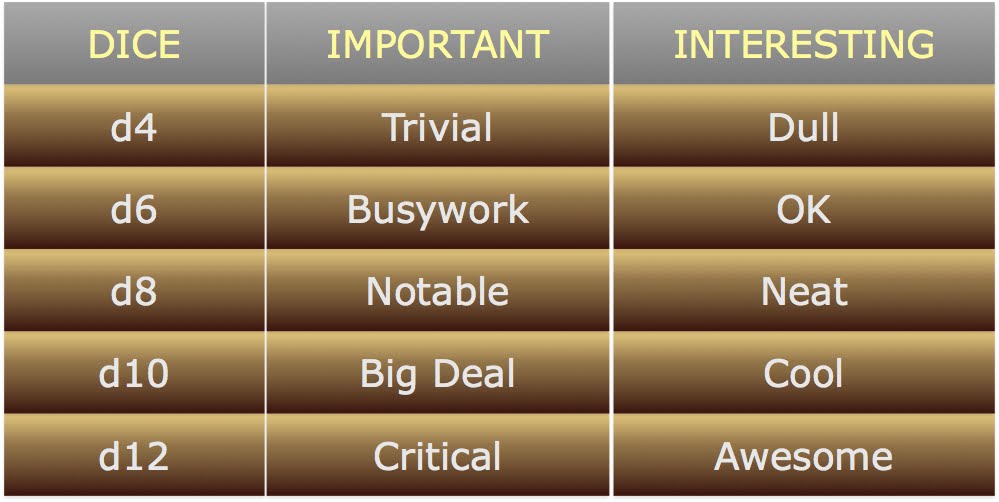
A cinematic model of difficulty hinges on two axes: is the task important, and is it interesting? These are possibly counterintuitive to someone who is used to thinking purely in terms of whether the task is difficulty or not, and if this is too weird for you to think about, consider that interesting and difficulty usually go hand in hand, and I'll treat them as a pair in my examples.
Important, however, is the rub. If we were shooting the movie of this game, how important is this task? Is it a trivial distraction, like distracting a barrista to get a free scone? Or is it something critical and high stakes, like disarming the bomb before the timer reaches zero? Important tasks are, by their nature, high tension and high risk, and the size of the importance die reflects that. Identical tasks can have different importance depending on the context - picking a lock may be only moderately important in a bus terminal, but it's much more important when the water is rising and the sharks have just been released.
Interesting also ties into the movie of the game: how cool would this scene be to see? How exciting is it? How awesome will it look if the character pulls it off? Hard things tend to be more interesting, at least so long as they're visible to the viewer: one math problem is probably about as interesting to the viewers as another, which is to say, not terribly.
The net result of embracing these two axes is that the cooler the roll is, the harder it will be. Think about that for a moment - the greatest reward will be the most difficult to achieve. There is a specific, rewarding symmetry to that, and let me call out right now that it is not to everyone's tastes, but it's surprisingly adaptable. For example, many players take great satisfaction in reducing difficulties through careful planning, seeking to maximize their chances of success. At first blush, such players might seem at odds with this approach, but consider that these machinations may be seen as turning down the Interesting Dial (as things are now a little less seat-of-the-pants). That player is rewarded with what he wants - less risk, greater certainty.
Which leads to the abuse. Players can, theoretically, game the system by doing boring, unimportant things, and I say, more power to them. Sometimes that's what people want, and if success doesn't change their behavior, then it's good to be able to support it.
Anyway, this is hardly applicable to every game, but on the off chance it tickles your fancy, I use the table below.

(And as a bonus guideline, if you find yourself sitting there with 2d4 in your hand, it may be a cue to ask yourself: Does this even need to be rolled?)
EDIT: Quick clarification for those unfamiliar with Cortex: it is effectively an Xk2 system, which is to say, you roll some number of dice (minimum two) and keep the two highest. In this case, it's assumed those two dice are I&I. In the specific implementation used for Leverage, 1's create problems, so d4s are effectively penalties on a roll: They do not help the total much, and they increase the odds of rolling a 1. Thus, something that's Awesome and Trivial would be d12 + d4, and while that averages decently (at 9, same as 2d8) the odds of a 1 coming up are greater, and creating a problem for the GM. That is to say, GMs looking to not suck out, are well served to make things more interesting and important.
1 - Speaking strictly for Leverage, you should really only do this for truly one-off rolls. If something's going to call for multiple rolls, the Fixer should add a real attribute for them. That said, for other games, you might want to assume the GM has an infinite supply of Normal Things, and only require spending to bump any of those up, or add additional values.
Those are all good reasons to go with difficulties, but turn them a few degrees and I find them a persuasive argument for using opposed rolls all the time. Why? Because the opposed roll forces the GM to think about the roll, enough to ask herself "Is this really worth rolling for? Am I really ready for this to be interesting, however it turns out?". That little bit of extra thought can make all the difference between keeping a game cracking along and getting hung up on some stupid roll going wrong. Obviously, rolls will go wrong with opposed rolls too, but the GM should be more prepared for that outcome.
That said, setting difficulties in Cortex is not always intuitive. If the GM has a whole lot of attributes out on the table, then she can usually build a roll out of them, but that's not a reliable resource. Sometimes the material's just not there, sometimes your players go off in another direction entirely, and none of the material you have on hand are of any use.
In the absence of that, I suggest some guidelines for creating difficulty based on two words that you can assume almost everything has: "Normal d6" and "Thing d6." That is to say, if you need to roll for the security guard in a complete absence of other information, then he's a Normal Thing (or Guy, in this case), so 2d6. Easy peasy. Structurally, this is an extension of the basic rule that you fill in empty slots with d6s, but conceptually the difference is all about making sure there is language to these things.[1]
Assuming one-off rolls, this is not always going to make sense. Sometimes roll should be pretty trivial, but you're willing to call it to fish for complications. Sometimes a roll will simply be harder solely because the player is making it harder (such as, for example, trying to con someone in a language he speaks badly rather than his native tongue). For those situations, I suggest that a cinematic model of difficulty can be applied.
A cinematic model of difficulty hinges on two axes: is the task important, and is it interesting? These are possibly counterintuitive to someone who is used to thinking purely in terms of whether the task is difficulty or not, and if this is too weird for you to think about, consider that interesting and difficulty usually go hand in hand, and I'll treat them as a pair in my examples.
Important, however, is the rub. If we were shooting the movie of this game, how important is this task? Is it a trivial distraction, like distracting a barrista to get a free scone? Or is it something critical and high stakes, like disarming the bomb before the timer reaches zero? Important tasks are, by their nature, high tension and high risk, and the size of the importance die reflects that. Identical tasks can have different importance depending on the context - picking a lock may be only moderately important in a bus terminal, but it's much more important when the water is rising and the sharks have just been released.
Interesting also ties into the movie of the game: how cool would this scene be to see? How exciting is it? How awesome will it look if the character pulls it off? Hard things tend to be more interesting, at least so long as they're visible to the viewer: one math problem is probably about as interesting to the viewers as another, which is to say, not terribly.
The net result of embracing these two axes is that the cooler the roll is, the harder it will be. Think about that for a moment - the greatest reward will be the most difficult to achieve. There is a specific, rewarding symmetry to that, and let me call out right now that it is not to everyone's tastes, but it's surprisingly adaptable. For example, many players take great satisfaction in reducing difficulties through careful planning, seeking to maximize their chances of success. At first blush, such players might seem at odds with this approach, but consider that these machinations may be seen as turning down the Interesting Dial (as things are now a little less seat-of-the-pants). That player is rewarded with what he wants - less risk, greater certainty.
Which leads to the abuse. Players can, theoretically, game the system by doing boring, unimportant things, and I say, more power to them. Sometimes that's what people want, and if success doesn't change their behavior, then it's good to be able to support it.
Anyway, this is hardly applicable to every game, but on the off chance it tickles your fancy, I use the table below.
(And as a bonus guideline, if you find yourself sitting there with 2d4 in your hand, it may be a cue to ask yourself: Does this even need to be rolled?)
EDIT: Quick clarification for those unfamiliar with Cortex: it is effectively an Xk2 system, which is to say, you roll some number of dice (minimum two) and keep the two highest. In this case, it's assumed those two dice are I&I. In the specific implementation used for Leverage, 1's create problems, so d4s are effectively penalties on a roll: They do not help the total much, and they increase the odds of rolling a 1. Thus, something that's Awesome and Trivial would be d12 + d4, and while that averages decently (at 9, same as 2d8) the odds of a 1 coming up are greater, and creating a problem for the GM. That is to say, GMs looking to not suck out, are well served to make things more interesting and important.
1 - Speaking strictly for Leverage, you should really only do this for truly one-off rolls. If something's going to call for multiple rolls, the Fixer should add a real attribute for them. That said, for other games, you might want to assume the GM has an infinite supply of Normal Things, and only require spending to bump any of those up, or add additional values.
Monday, December 6, 2010
The Second Adventure Triad
Ok, to refresh, I posited that the three main models of adventure motivation are Procedural (sequence of scenes or reverts towards a dramatic or appropriate conclusion), Goal-driven (moderately open play with a goal providing overall direction) and Situational (Where the characters are put in a situation which will evolve based on their play).
I present these as a triad rather than a sequence because it is not hard for these to bleed into one another, and in reality, it is rare for a game to move purely to one of these points, and rarer still for it to stay there. Instead, actual play moved towards the spaces in between these points, and those can be described in broad terms.
Between Situation and Procedure, we have Exploration play, which it might more accurately call progression. The model is simple: When play begins, the players are in a particular place or state (such as the small town near the low level dungeon), and as the game progresses, the range of places available to to the players expands. This is probably most commonly seen in video games, but it's also a common part of D&D and D&D style adventures. The 4e model of moving from the world to the inner planes and on to the outer plains is also a good example of this. The procedural element revolves around the progression from zone to zone, as it were, but it's still largely situational because those "zones" are large may have a lot of scope for play within them.
The Quest is a combination of Procedure and Goal based play: it's got a clear goal (the object of the quest) but there's a chain of steps to go through to get to that point - to kill the dragon, you have to get the sword, to get the sword you have to find the tomb, to find the tomb you need to brave the archives and so on.
Finally, between Goal and Situation, you have Sandbox style play. There's an ultimate objective in the form of the goal, but there's no real limit on how the characters are going to proceed nor at what pace.
So, that puts us up to six models, but the important thing to note is that NONE of these models automatically translate into a good or bad game, nor even faintly trend that way. Each one of those models can be used to build a very good adventure or a truly abysmal one. I'm not just speaking in terms of personal taste - I mean really, genuinely terrible adventures.
That said, these models _can_ be useful when it comes time to talk with players about the game. If you can talk about the models directly then that's probably easiest, but even if you don't speak in explicit terms, it's something to keep in mind as they talk about the sort of game they expect.
I present these as a triad rather than a sequence because it is not hard for these to bleed into one another, and in reality, it is rare for a game to move purely to one of these points, and rarer still for it to stay there. Instead, actual play moved towards the spaces in between these points, and those can be described in broad terms.
Between Situation and Procedure, we have Exploration play, which it might more accurately call progression. The model is simple: When play begins, the players are in a particular place or state (such as the small town near the low level dungeon), and as the game progresses, the range of places available to to the players expands. This is probably most commonly seen in video games, but it's also a common part of D&D and D&D style adventures. The 4e model of moving from the world to the inner planes and on to the outer plains is also a good example of this. The procedural element revolves around the progression from zone to zone, as it were, but it's still largely situational because those "zones" are large may have a lot of scope for play within them.
The Quest is a combination of Procedure and Goal based play: it's got a clear goal (the object of the quest) but there's a chain of steps to go through to get to that point - to kill the dragon, you have to get the sword, to get the sword you have to find the tomb, to find the tomb you need to brave the archives and so on.
Finally, between Goal and Situation, you have Sandbox style play. There's an ultimate objective in the form of the goal, but there's no real limit on how the characters are going to proceed nor at what pace.
So, that puts us up to six models, but the important thing to note is that NONE of these models automatically translate into a good or bad game, nor even faintly trend that way. Each one of those models can be used to build a very good adventure or a truly abysmal one. I'm not just speaking in terms of personal taste - I mean really, genuinely terrible adventures.
That said, these models _can_ be useful when it comes time to talk with players about the game. If you can talk about the models directly then that's probably easiest, but even if you don't speak in explicit terms, it's something to keep in mind as they talk about the sort of game they expect.
Friday, December 3, 2010
The Adventure Triad
There was an interesting question put forward in the comments yesterday that got me thinking about the structure of adventures. I was talking about goal-based vs. procedural adventures, and a commenter asked what these categories are. I had never given it much thought, so I chewed on this a bit to try to figure out what categories there might be.
The thing that surprised me is that there were fewer than I expected. Sticking within the bounds of more normal adventures, which is to say I'm excluding meta-play adventures, where the player's role is more akin to an author, and with those aside, there are three big categories - Situational, Procedural and Goal oriented. They're not exclusive (more on that in a minute) but they have different priorities.
Situational play centers around characters inserted into an already-detailed situation, whether dynamic or static, and bouncing around within it, observing, interacting, and often changing the rest of the situation. The GM tends to do a fair amount of work up front, and then depend up skills of improvisation to keep the situation feeling realistic and compelling. A game like Amber, which revolves around the machination of an extended family is a good example of a situational game.
Procedural play is based on the the idea of sequential events, strung together to create a coherent chain of events (or, if you're feeling risky... a story). The GM needs to do a fair amount of prep for this as well, but it's more focused than that for situational play - if you imagine Situational design as a large box full of stuff, procedural play is a series of smaller boxes. It's easier to come up with a procedural game, but the situational material is more reusable. Mysteries are great examples of this.
Goal oriented play is, as the name suggests, centered around a goal the players are looking to accomplish. The framework around the the goal might be loose or structured, but the goal is always the thing that drives play. Leverage is almost purely goal oriented - without a goal, the game doesn't work well.
Knowing these approaches can help prevent confusion when you want to run a game, since these approaches also speak to player expectations. When a player anticipates a situation game, where he's going to have a lot of freedom to wander towards whatever shiny object catches his attention, he's going to get very frustrated if the GM is expecting procedural play.
Now, by themselves, these three elements create a a very limited picture of what's really going on in play. While they are practical methods of play, very few games are going to be purely one thing or another. These ideas inform play, but you start seeing more interesting things in between them, where these ideas combine, and where this:

Starts to look more like this:

So what are those three new categories? Stay tuned!
The thing that surprised me is that there were fewer than I expected. Sticking within the bounds of more normal adventures, which is to say I'm excluding meta-play adventures, where the player's role is more akin to an author, and with those aside, there are three big categories - Situational, Procedural and Goal oriented. They're not exclusive (more on that in a minute) but they have different priorities.
Situational play centers around characters inserted into an already-detailed situation, whether dynamic or static, and bouncing around within it, observing, interacting, and often changing the rest of the situation. The GM tends to do a fair amount of work up front, and then depend up skills of improvisation to keep the situation feeling realistic and compelling. A game like Amber, which revolves around the machination of an extended family is a good example of a situational game.
Procedural play is based on the the idea of sequential events, strung together to create a coherent chain of events (or, if you're feeling risky... a story). The GM needs to do a fair amount of prep for this as well, but it's more focused than that for situational play - if you imagine Situational design as a large box full of stuff, procedural play is a series of smaller boxes. It's easier to come up with a procedural game, but the situational material is more reusable. Mysteries are great examples of this.
Goal oriented play is, as the name suggests, centered around a goal the players are looking to accomplish. The framework around the the goal might be loose or structured, but the goal is always the thing that drives play. Leverage is almost purely goal oriented - without a goal, the game doesn't work well.
Knowing these approaches can help prevent confusion when you want to run a game, since these approaches also speak to player expectations. When a player anticipates a situation game, where he's going to have a lot of freedom to wander towards whatever shiny object catches his attention, he's going to get very frustrated if the GM is expecting procedural play.
Now, by themselves, these three elements create a a very limited picture of what's really going on in play. While they are practical methods of play, very few games are going to be purely one thing or another. These ideas inform play, but you start seeing more interesting things in between them, where these ideas combine, and where this:

Starts to look more like this:

So what are those three new categories? Stay tuned!
Thursday, December 2, 2010
Roads, Not Railroads
Ken Hite recently ruffled a few feathers by declaring at a seminar that “Railroading is a pejorative term for a game in which something is accomplished.”
It’s an easy point to argue (as the nice people at rpg.net have demonstrated) but doing so rather misses the point. The purpose of a generalization like that is not to be true, but rather, to be useful. I have spent no small amount of time talking about how to avoid railroading in games, both as a GM and as an adventure designer, but there’s an important point that runs through all those warnings: there are very good reasons that people railroad.
Now, yes, there are also bad reasons. The nightmare scenario is the adventure which consists pretty much entirely of watching the GM do a puppet show of the story which is totally going to be the basis of that novel which is going to make him famous when he gets around to writing it. Nobody wants that, and when it’s the adventure designer who writes the puppet show, that’s even worse because it just encourages that sort of behavior.
There is also a somewhat more dull sort of railroading that occurs when the player’s stray from the GM’s notes. The classic example of this is the unfinished dungeon map, where the characters are steered away from the parts that haven’t been filled in yet. This example sticks in the mind because a lot of us have experience with it (from our own days of vast dungeons scratched out in pencil on graph paper) but I think it’s a less important one, if only because it’s a hallmark of inexperience, not a true technique. That is to say, more experienced GMs don’t have this problem because they have taught themselves how to wing it in those situations, or they have learned not to use incomplete dungeons.
But the main reason good GMs railroad is, to come back to Ken, to make things happen. The railroad is the through-line of the adventure, the sequence of events that makes it all make sense. It’s not something every game needs to work - it can be equally effective (if more work) to craft a compelling, dynamic situation and insert the characters - but having a through-line helps insure a satisfying conclusion. This is especially true in adventures that have a clearly procedural bent, where the first action leads to the second action and so on (you see this a lot in police mysteries and revenge stories). For these games, that process is a bit of a necessity - skipping over bits tends to either be impossible (because key information is missing or because key steps are left undone - like missing a target or failing to get proper evidence for a conviction).
It’s easy to characterize that sort of game as railroading, but the reality is it’s just a good match for the game in question. The problem comes when that same model is misapplied, either to adventures where it’s a mismatch (such as objective based ones) or handled poorly.
For an objective based game (rescue the princess, steal the widget), players can easily get frustrated if there is only one path to the objective (especially if that path is kind of stupid). One of the joys of fiction and play is unexpected solutions to sticky problems, and given a clear goal, you can expect players to pursue those unexpected solutions with great vigor. Designing such a game with only one path to success invites frustration, especially if that path is easily circumvented (as in the case of an adventure where players can skip large parts of the middle by flying rather than walking).
That frustration tends to lead to the reason railroading is a pejorative - the bad GMing techniques that emerge when players go off the tracks. When players deviate from the script, the GM can choose to roll with it and see where it goes, but she might also choose to try to force the players back onto the right track by force and trickery. Maybe it’ll be subtle enough to feel organic, but it can escalate pretty easily. The GM’s gentle nudge fails, so it becomes a hint, which becomes a push, which becomes a blatant abuse of authority and things end up feeling crappy for everyone.[1]
Obviously, that’s something to avoid, but that’s not hard - it’s a failure of technique more than anything else. Realizing that you’re setting up a railroad for a situation that is a poor match can save you a ton of hassles down the line and by extension, recognizing the same in published games can save you similar hassles.
In the end, I would advise most GMs to think in terms of roads rather than railroads. Feel free to build in those plot threads and through-lines and have them go interesting places. You and your players will probably find it rewording, and if done well, your players will stick to the roads more often than not. But unlike railroads, there’s no disaster when someone swings off a road in an unexpected direction. The trip may be a bit bumpier, but that doesn’t mean it won’t go someplace cool.
1 - This can happen even when the GM doesn’t have a plot of through-line in mind, and is instead merely thrown off by the players circumventing his brilliant encounters. This is even more petty, and there tends to be a streak of vindictiveness to it as the GM seeks to punish the players for “outsmarting” him. This is not a technique, it’s just being a douche, but enough people have seen it in action that it’s left long scars across the hobby.
It’s an easy point to argue (as the nice people at rpg.net have demonstrated) but doing so rather misses the point. The purpose of a generalization like that is not to be true, but rather, to be useful. I have spent no small amount of time talking about how to avoid railroading in games, both as a GM and as an adventure designer, but there’s an important point that runs through all those warnings: there are very good reasons that people railroad.
Now, yes, there are also bad reasons. The nightmare scenario is the adventure which consists pretty much entirely of watching the GM do a puppet show of the story which is totally going to be the basis of that novel which is going to make him famous when he gets around to writing it. Nobody wants that, and when it’s the adventure designer who writes the puppet show, that’s even worse because it just encourages that sort of behavior.
There is also a somewhat more dull sort of railroading that occurs when the player’s stray from the GM’s notes. The classic example of this is the unfinished dungeon map, where the characters are steered away from the parts that haven’t been filled in yet. This example sticks in the mind because a lot of us have experience with it (from our own days of vast dungeons scratched out in pencil on graph paper) but I think it’s a less important one, if only because it’s a hallmark of inexperience, not a true technique. That is to say, more experienced GMs don’t have this problem because they have taught themselves how to wing it in those situations, or they have learned not to use incomplete dungeons.
But the main reason good GMs railroad is, to come back to Ken, to make things happen. The railroad is the through-line of the adventure, the sequence of events that makes it all make sense. It’s not something every game needs to work - it can be equally effective (if more work) to craft a compelling, dynamic situation and insert the characters - but having a through-line helps insure a satisfying conclusion. This is especially true in adventures that have a clearly procedural bent, where the first action leads to the second action and so on (you see this a lot in police mysteries and revenge stories). For these games, that process is a bit of a necessity - skipping over bits tends to either be impossible (because key information is missing or because key steps are left undone - like missing a target or failing to get proper evidence for a conviction).
It’s easy to characterize that sort of game as railroading, but the reality is it’s just a good match for the game in question. The problem comes when that same model is misapplied, either to adventures where it’s a mismatch (such as objective based ones) or handled poorly.
For an objective based game (rescue the princess, steal the widget), players can easily get frustrated if there is only one path to the objective (especially if that path is kind of stupid). One of the joys of fiction and play is unexpected solutions to sticky problems, and given a clear goal, you can expect players to pursue those unexpected solutions with great vigor. Designing such a game with only one path to success invites frustration, especially if that path is easily circumvented (as in the case of an adventure where players can skip large parts of the middle by flying rather than walking).
That frustration tends to lead to the reason railroading is a pejorative - the bad GMing techniques that emerge when players go off the tracks. When players deviate from the script, the GM can choose to roll with it and see where it goes, but she might also choose to try to force the players back onto the right track by force and trickery. Maybe it’ll be subtle enough to feel organic, but it can escalate pretty easily. The GM’s gentle nudge fails, so it becomes a hint, which becomes a push, which becomes a blatant abuse of authority and things end up feeling crappy for everyone.[1]
Obviously, that’s something to avoid, but that’s not hard - it’s a failure of technique more than anything else. Realizing that you’re setting up a railroad for a situation that is a poor match can save you a ton of hassles down the line and by extension, recognizing the same in published games can save you similar hassles.
In the end, I would advise most GMs to think in terms of roads rather than railroads. Feel free to build in those plot threads and through-lines and have them go interesting places. You and your players will probably find it rewording, and if done well, your players will stick to the roads more often than not. But unlike railroads, there’s no disaster when someone swings off a road in an unexpected direction. The trip may be a bit bumpier, but that doesn’t mean it won’t go someplace cool.
1 - This can happen even when the GM doesn’t have a plot of through-line in mind, and is instead merely thrown off by the players circumventing his brilliant encounters. This is even more petty, and there tends to be a streak of vindictiveness to it as the GM seeks to punish the players for “outsmarting” him. This is not a technique, it’s just being a douche, but enough people have seen it in action that it’s left long scars across the hobby.
Wednesday, December 1, 2010
Hacking the Hacker
People have been talking about ways to hack Leverage to play games of a similar style in different settings. There are a lot of possibilities for this - there are very few genres which can’t support a good caper (or at least a team of awesome folks executing on plans) so there’s a lot of potential different places to take it. This introduces a lot of questions for how to support these other genres, especially when they don’t quite match up with the roles of the core game.
Four of the roles are pretty portable - Hitter, Thief, Grifters and Masterminds are pretty universal. You might want to change the names for tone - Soldier, Burglar, Charmer and Leader - but the basic functionality is just about the same. The problem comes in the form of how you handle the Hacker.
Now, yes, some Hacker skills, such as forgery, are nicely portable, the thematic core of the role revolves around computers, networks and such fun things. That demands a fairly narrow band of time, either the reasonably recent past (say, post War Games) to the near future (think Cyberpunk) with brief side jaunts into alt-history where the goggles and gears annoy Charles Stross. So when you step outside of that sphere, what do you do with the hacker?
The first option is to see if there’s a setting equivalent for technology. This may take the form of magic, but only if the magic is fairly low key. For example, Scott Lynch’s Lies of Locke Lamora has magic, but it’s so powerful that making hacker into mage would be simply overwhelming. However, the setting has very interesting Alchemy, and that would probably be a much better match. It makes a good match for some of the sort of things the hacker does, especially producing gadgetry.
Similarly, you could easily enough use a kind of “low magic”[1] stand in for hacking (in my mind, I’m imagining Egg Chen from Big Trouble in Little China as an example of this). In some ways it’s an almost perfect match. You can produce little relics, scry for information and so on. This is just one way to handle magic in the Leverage system, but that’s a topic I’ll get into more some other time.
The other possible approach is to treat hacking as a signature of the genre. That is to say, hacking is a signifier for a certain time-range and style of play, and in other genres, the signifier might be something else. Consider, for example, the Pilot in a game based loosely off Firefly - it’s a role that is very important to that sort of group, and while it may not have any similarities to the hacker in terms of what the character _does_, but it’s similar in term of how it fits into the group. Of course, the one problem with using Pilot as an example is that you need to make sure that it comes up as often as the other roles do in play. Pilot tends to be a little bit rough in actual play because the ship just sort of goes most of the time.
This approach takes a little more work (especially because it means rewriting the talents rather than simply reskinning them) but it’s the sharp point for how to start making a more drastic change to the system to capture other genres and ideas. And that’s almost certainly where the path leads next.
1 - As contrasted with the Fireball tossing magic of the usual D&D mage.
Four of the roles are pretty portable - Hitter, Thief, Grifters and Masterminds are pretty universal. You might want to change the names for tone - Soldier, Burglar, Charmer and Leader - but the basic functionality is just about the same. The problem comes in the form of how you handle the Hacker.
Now, yes, some Hacker skills, such as forgery, are nicely portable, the thematic core of the role revolves around computers, networks and such fun things. That demands a fairly narrow band of time, either the reasonably recent past (say, post War Games) to the near future (think Cyberpunk) with brief side jaunts into alt-history where the goggles and gears annoy Charles Stross. So when you step outside of that sphere, what do you do with the hacker?
The first option is to see if there’s a setting equivalent for technology. This may take the form of magic, but only if the magic is fairly low key. For example, Scott Lynch’s Lies of Locke Lamora has magic, but it’s so powerful that making hacker into mage would be simply overwhelming. However, the setting has very interesting Alchemy, and that would probably be a much better match. It makes a good match for some of the sort of things the hacker does, especially producing gadgetry.
Similarly, you could easily enough use a kind of “low magic”[1] stand in for hacking (in my mind, I’m imagining Egg Chen from Big Trouble in Little China as an example of this). In some ways it’s an almost perfect match. You can produce little relics, scry for information and so on. This is just one way to handle magic in the Leverage system, but that’s a topic I’ll get into more some other time.
The other possible approach is to treat hacking as a signature of the genre. That is to say, hacking is a signifier for a certain time-range and style of play, and in other genres, the signifier might be something else. Consider, for example, the Pilot in a game based loosely off Firefly - it’s a role that is very important to that sort of group, and while it may not have any similarities to the hacker in terms of what the character _does_, but it’s similar in term of how it fits into the group. Of course, the one problem with using Pilot as an example is that you need to make sure that it comes up as often as the other roles do in play. Pilot tends to be a little bit rough in actual play because the ship just sort of goes most of the time.
This approach takes a little more work (especially because it means rewriting the talents rather than simply reskinning them) but it’s the sharp point for how to start making a more drastic change to the system to capture other genres and ideas. And that’s almost certainly where the path leads next.
1 - As contrasted with the Fireball tossing magic of the usual D&D mage.
Subscribe to:
Posts (Atom)