Wednesday, October 5, 2011

Roleplay and Exploration Rewards

I was struck by a tweet this morning regarding the difficulty with handing out XP awards for exploration and roleplaying, specifically, that such rewards are arbitrary and hard to rightsize. This immediately struck me as a very valid complaint, but also one that's very easily addressable - it's just a matter of identifying the behaviors and experiences to reward, then plugging them into the reward system. For illustration, I'll be using 4e to show how to do this (primarily because it's standard reward model is very robust) but the basic idea can be used for almost any XP-driven game, especially ones with the idea of an encounter.

For purposes of awards, I'm going to provide a loose definition of both roleplaying (as a specific subset of play) and exploration. RP is, practically, engaging some element of the setting. This may seem like a strange definition if your first thought is that it's talking in a funny voice or getting very emotional at the table, but those are just ways to go about engaging the setting - that is, ways to meaningfully interact with the setting as if it matters. This can range from involved conversations with NPCs to hard choices about the fate of nations.

Exploration is a little bit easier to quantify - it's the process of adding something to the mental (and sometimes physical) map of the campaign. When the players explore The Dungeon of Doom then they get certain rewards just for being there (assuming that there are fights and challenges in a place called The Dungeon of Doom) but they have also added TDoD to the landscape. In the future, new enemies might take it as a lair, or maybe people will try to reclaim it. It's now a thing, and that makes it part of the campaign. Exploration is the process by which these things (which might properly be people, places or things) get added to the game.

These two elements may seem difficult to standardize for rewards, but they share a common idea which can tie this all together. Both rotate around the idea of campaign elements - either engaging them or adding them - and it's not difficult to systemize that. All it takes is a list.

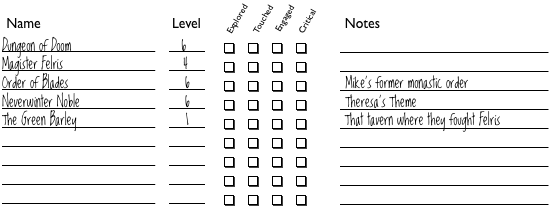
I'm going to call this list the Game Log for simplicity sake, but the name isn't important. What matters is that it's a list of the elements that come up over the course of a campaign. It will grow over time, and it provides a valuable resource for GMs, both to handle XP awards and to provide a little inspiration when designing adventures. The log looks like this:
sample.png

(You can download a PDF of the form here)

Using the Form


The Name column is for the name of the element. Elements might be anything that can recur in a game, limited only by the taste of the GM. This includes locations, NPCs and organizations, but it can also include character elements. Themes (as presented in the Neverwinter campaign setting) are another great example of a possible element.

Just keeping a list like this is useful to an GM, and most of us already keep it in one form or another, if only to answer the "Ok, who was that guy with that thing that one time?" kind of questions that pop up during play.

The level is a little bit less obvious. While it's tied to the idea of character level, it does not have exactly the same meaning. Practically, level is a measure of how important an element is, with the most important elements having a level equal to the current level of the characters. Mechanically, this is tied to XP rewards (we'll get to that in a second) but it also is a useful way to keep track of what is an isn't used in a campaign.

Generally speaking, when an element is introduced, it will probably be at the character's current level. It may "level up" any time it is engaged (see below) but it shouldn't go beyond the character's current level unless it's something the GM really wants to emphasize. That's the default assumption, but there are a few tricks that can be played - GMs looking to experiment in allowing players to introduce elements in play may allow them to do so, but start those elements out at level 1, and force them to grow in importance through play.

The checkboxes are for use in play, to indicate what's happened. "Explored" is the most straightforward - you check that box the same time you add something to the list (or, if you already had it on the list, when the players first encounter it). An element should only be explored once in its lifetime, so once this box is checked, it stays checked.

The other boxes - Touched, Engaged and Critical, see a bit more action. When an element comes up in play, you check the box that corresponds to how it came up.

If it was a memorable but unimportant part of play, then check "Touched". This is appropriate if an NPC was visited, a scene happened at a particular location, or the players talked about a thing.

If it was a noteworthy part of play, then check "Engaged". The line between touched and engaged is a bit subjective, but that's an intentional nod to GM taste. In general, something should be considered engaged when it provided a strong motivation for play or created a cost or a choice. If the players had to have an extended negotiation with an NPC or their favorite bar burned down, that would be engaged.

One trick that comes in handy is looking where else rewards are coming from. if the negotiation with the NPC is also a skill challenge, then the negotiation itself may not merit an Engaged tickmark (though it probably merits a "Touched") but if the skill challenge _also_ engages the players and characters, then yes, it totally merits a check.

"Critical" is like engaged, but moreso. If the interaction is particularly central to play, or is a turning point in the campaign, then Critical gets checked. The GM will probably know when a Critical interaction is coming, since it's usually a result of the GM doing something awful to or with the element, but it's possible to be surprised, and this is what to check if your players really blow you away.

The notes field is, as you might expect, where you keep notes. Hopefully self explanatory.

The Form and Rewards


At the end of a session, you should have a few checkmarks that indicate the things that your players found and engaged. Turning that into a reward is based on the idea of a standard award, and this is why I use 4e to illustrate.

The standard award is an amount of XP equal to that given for a monster of a given level, in this case, the level of the element (I told you that would come in handy). The basic idea is that an "Explore" or "Engaged" checkmark gets the standard award, while a "Touched" checkmark awards a fractional reward, and a "Critical" result provides a bonus. In 4e terms, these line up roughly with a minion and an elite (so 1/4x and 2x respectively).

Thus, for example, let's say that the players interact with a level 4 elements.
For discovering the element, they gain 175 XP.
If they touch on it, then the award is 44 XP.
If they engage is, then the award if 175 XP.
If engagement with it is critical to the game, then the award is 350 XP

Note - Only give the highest award, though you may give an exploration and engagement award if both seem warranted.

Run down the list, tally the awards, pool them, then divvy them among the players. Simple as that.

Notes and Thoughts


Exploration Games: You can change the proportions a bit if you want to emphasize or de-emphasize exploration. If exploration is critical to the game, then the reward for an explore tick might be as much as 5x a standard award.

Long List: So, what keeps the list from getting crazily long? While GM editorial oversight (especially the decision whether or not something goes on the list or not) plays a role, then I suggest the following trick: After an element gives its exploration award, drop its level to 1, and let it level back up in play. This means that players will get better rewards for working within a smaller list than they will by constantly having things get added, which nicely simulates the conservation of characters and locations you see in most fiction. It also provides the GM a handy tool that reveals which elements the players actually care about based on which ones get leveled up.

Personal Awards: Note that this model explicitly rewards the entire group equally for roleplaying, and I admit that's something I very strongly endorse, but on the off chance that you want to reward star players, then it's a fairly simple matter of noting the star performer in the notes column, then not adding the reward for that element to the pool, and give it directly to the player.

Slightly more complicated is the issue of personal character elements - that is, should everyone get rewarded when a given character's theme becomes important to play. My answer is a profound "yes", but if that is not to your taste, then you may consider some elements to be "owned" by a specific character, and have the reward go directly to that character rather than into the pool.

But I really suggest against it. Not only does it introduce the bookkeeping hassle of mismatched XP and the social hassle of rewarding the loudest players, it removes the incentive for players to celebrate each others awesome. If only you get rewarded for your character theme, then only you will look for ways to hook it in. If everyone is rewarded for it, then everyone's looking to bring it into play. That's a vastly preferable arrangement in my mind.

Other Systems: As noted, while it's easiest to do this with 4e, if you can figure out the standard award for your game, the model translates easily enough. Heck, you can even do thematic versions. For example: for a white wolf game, I'd forgo levels in favor of rating things from 1-5 dots and just be a little more stingy about how they level up.

Monday, October 3, 2011

The Instinct for Scenes

One of the hallmarks of getting very good at something is that certain elements become habit. A musician doesn't really think about tuning his instrument or running through a few familiar tunes. An athlete just falls naturally into proper form. This is one of those things that's hard to measure because it's not what they do that distinguishes them - anyone can do that with a little effort - but how they go about doing so.

For storytellers of various stripes, one of the ways this manifests is as an instinct for scenes. They see something - a person, an idea, whatever - and they are struck by ways in which you might do something neat with it. Like other instincts of expertise, this is something that anyone can do with a little thought, but with experience, the possibilities tend to jump up and smack the storyteller in the face.

This, far more than any ideas about grand narratives, is the skill from storytelling that translates most strongly to GMing. The most consistent challenge that the GM faces is "How can I make this work?" and a lot of the worst habits of GMing emerge when no answer presents itself. Fiat rears its ugly head when the GM doesn't have a way to work with the current situation, and thus she forcefully changes it. Not only does that kind of stink on its own, it also usually means the GM is ignoring or dismissing an element that a player brings to bear, leaving the player that much more alienated.

Now, here's an important note: this is not just a hippy-dippy narrative problem. When you deal with hard core game-playing, one of the big appeals of RPGs is that it supports opportunities to think outside the box. When presented with a challenge, you can engage the environment in unexpected ways to achieve clever solutions. These solutions are every bit as much a player-initiated game element as the more story-oriented player who uses a bit of narrative authority to talk about an old girlfriend they left in this town. We invest a lot if energy in differentiating these different types of player ideas, but in the end, they're all ideas, and how the GM handles them says much more about the game than any other division.

The good news is that this instinct doesn't require that you be a writer or the like to practice. You get a little bit better at it every time you see things take a turn in a game and think, "Ok, how would this look if this were what this session were about?" Brainstorm ideas, kick them around, think what you would do with them. Steal plot twists and macguffins from TV, Movies and books and think about ways you could have handled them. In time, it becomes habit, and that does good things for your games, provided you commit to it. And that reveals the tricky part.

While the obvious part of the equation is being creative, the less obvious (and perhaps even more critical) part is being attentive. Most of us know what to do when an opportunity is presented to us, but the danger is that we can easily overlook when opportunities arise. If we don't make an effort of listening to our players and paying attention to when things shift, we'll miss our chance.

Practicing attentiveness is a little harder than practicing creativity, but it can be done. Every situation where you pay attention to people and what they want can help, not just games. It's not very different from being a good conversationalist (rather than merely dominating a conversation). And thankfully, it's one of the easiest things to talk to your players about after a game, because it's easy to couch the question in non-confrontational terms - "Are there any threads or events that came up in the game that you wish had been pursued?" is a pretty innocuous question, but it can reveal a lot.

So, creativity and attention: make a habit of them.

Editor's Note: I've changed my posting time from 10am eastern to 1pm eastern, just to be kinder to the west coast.

Wednesday, September 28, 2011

Status Update

So, the silent period ran longer than planned. New job has been great, but it's eaten a bit of my brain as I ramp up.

Thankfully, that corner has been rounded. Regular posting will resume this coming Monday.

Tuesday, September 13, 2011

Geek #2: Productivity

This is my second Speak Out With Your Geek Out post.

I am also a productivity geek. This has shown up in a few of my gaming posts like "Getting Things Dungeon" but it's something that runs pretty deep for me.

Like a lot of people I know, I was a bright slacker growing up. I was smart and flexible enough to get by most of the time, and as I got out of college into the job market, this produced a generally relaxed attitude. There are plenty of situations where this was helpful, but there were others (most of which I was semi-willfully unaware of) where it hurt me. Sure, things might occasionally get chaotic enough to merit a big cleanup, but I was never going to "get organized", since that was something which uptight, type-A people did, and that was definitely not me. My desk (or room, or office) might be a mess, but I knew where everything was! I could do my work, and my natural method of handling things was much more organic and efficient than any system some anal retentive old dude might come up with!

(While I did not actually add the slightly plaintive "Maaaaan" at the end of it, if you add it with your imagination, you will have captured the essence of the thing).

Still, I was kept busy, and in one of my occasional efforts to get my stuff together, I stumbled across an article about Getting Things Done and I got pretty well sucked in. It spoke directly to my situation, and it flipped a simple, but really important switch. It asserted that the purpose of getting organized was not being organized, but rather to free up your mind, time and space so that you can actually focus on enjoying the things you love. I'd never considered it in that light before, but it nailed me pretty hard.

Now, the problem is that getting organized can be very distracting. Getting Things Done is a methodology that teaches a few simple ideas, but then allows for any number of implementations. The kinds of people that GTD works for are often the kind of people likely to spend a lot of time fiddling around with their system of tasks and planners, which kind of misses the point.

I've been guilty of that more than once myself, and I've tried almost every methodology I've come across at one point or another. I listened to Merlin Mann podcasts, got myself a hipster PDA, pursued inbox zero, tried autofocus and Franklin-Covey, sorted colored post-its. There was a lot of fun to be had in trying new systems. Even if they were ultimately a distraction, I often picked up a trick or two.

Nowadays I have my personal organization pretty well under control. I very grudgingly made the transition from a pocket notebook to an iphone, but it's been worth it, as measured by the fact that my tasks are getting done.

Anyway, I would not be a real geek unless I shared my workflow, so here it is.

Email is gmail, which is kept at inbox zero. Mails that I need to come back to are flagged as @followup (The @ is a trick to put those flags at the top of the list). Emails that I can see a clear task in are entered in my task system, then archived. EMail used to be a weak link for me - the web interface was never more than ok for me - but the new Mail client in OSX Lion was good enough to become my central dashboard. I'll do a little email management from my devices (iphone & ipad) but real cleanup and processing happens at the desktop.

For task handling, I use Omnifocus, which I have on all three machines, and which syncs automatically. The syncing is a big deal, since it lets me put things in my inbox quickly, then process them properly when I have more time. I love this solution, but it was really freaking expensive (and it has no web component) but it works very well with my process.

I make much greater use of contexts than I do projects. It may just be how I think, but projects are something I only really need to do if the tasks are not self-explanatory. This is a bit of a GTD violation, and I suspect that I'll go more project-heavy over time, but for now, they're not a big part of the system.

Notes, lists and data go into text files kept on Dropbox. I use Notational Velocity to access them on the desktop, and Elements from my iDevices. I chose Elements because it let's you customize your base directory in dropbox, and because while it's a good note app, I don't actually use it for writing, so it's a good dedicated notes tool.

I'm still looking for a good solution to handling larger ideas (like email thread with Fred containing game ideas). I dump them into Notational velocity for the time being, but that feels like a poor fix.

I do most of my straight writing on the iPad (usually in writeroom) synced to dropbox, then i just open it in the appropriate app for post-processing. Simple enough arrangement.

And that's about the size of it. Any other productivity geeks out there?


Monday, September 12, 2011

Geek #1: Comics

At first, I was uncertain how to contribute to Speak Out With Your Geek Out - after all, this is already a pretty geeky blog - but after a but of thinking I realized I have a few other areas of geekery that might merit some discussion, so I’m taking my week back from break to run through them.

So, I’m a bit of a comic geek. Not as much of ones as I used to be (for which my wallet thanks me) but enough that I stay on top of what’s going on in the mainstream comics, follow some small ones, and read far too many webcomics on a regular basis. This lead to the interesting experience of my going to the Small Press Expo for the first time this past weekend.

For the unfamiliar, SPX is an expo for independent comic artists and companies. Originally, it was fairly underground, populated by comics you’ve never heard of and people’s hand-bound photocopies, but over the years it has also become a large venue for web comics. SPX is a DC are con, and I have wanted to attend it for years, but I always end up missing it. Thankfully, a friend who is an even bigger comic nerd than I was going, so I hitched a ride.

First off, it was weird as heck going to a convention where I’m _not_ a super nerd. When I hit a gaming convention, it’s very familiar territory for me. There are people I know in many places, and even when that’s not the case, I have enough familiarity with what’s going on to be able to comfortably engage with people about whatever they’re doing. Not so much here - it was like flashing back to my first conventions experiences in college, which is not a great sensation. The introvert instincts kicked in, and there was a lot of listening and avoiding eye contact while wiggling through the crowd, though I did manage to engage the one or two artists I really wanted to talk to.

Second, it was really interesting from a business perspective. As Oltheros has noted more than once, small press comics and game publishing have crazy amounts of overlap, and laid out in the expo hall, some issues are even more clear. Bear in mind that since this is an expo, every table is selling something, and that’s the primary things it’s doing. It’s one of the reasons engagement is rough because you don’t want to ask a question and get bombarded with upsell (or to feel guilty for not buying what is clearly a labor of love).

So within that context, you have the full gamut of products, from the $100 gorgeous hardcovers to the $1 staple bound, probably hand-cut photocopies. And you have a LOT of them. This definitely creates a divide when you have very small products contrasted with the Topatoco table which runs the length of the wall with nothing but high production value material, but the divide is not so clear as you might think. Topatoco does great because people came to convention already knowing what they wanted, so there’s no real discovery there. That’s the real divide between the haves and a the have-nots: for most every other booth there, the job was to help people passing by to understand what they were selling and why it might be interesting.

The degrees of success at this were crazy to behold. Certainly, there was a correlation between production values and presentation, but it was far from a true distinction. There were booths of incomprehensible (but highly polished) product, just as there were tables with rough product that was very clearly presented. As in gaming, there is no small contingent in comics who strive for what they consider authenticity over commercial success, and those are the ones most likely to equate polish with presentation, but at SPX they also seemed the ones most likely to fail in thier own presentation for entirely non-commercial reasons.

It does not take a lot of money to keep a tidy table, to present your products well and to choose what you present wisely. This is as true of comics as it is with games, though more pronounced in comics - a game producer is a little less likely to have a dozen ashcans.

To come back to the point, I think part of being a multi-pronged geek is that you start seeing where your areas of enthusiasm overlap. It’s a glass bead game where the parallels between Blues Rock and Japanese Animation become self evident once you love the both of them enough. I dig that, and its one of the reasons I love finding new things to get enthusiastic about.

Friday, September 2, 2011

Time Off

I'm taking a long weekend for Labor day, and should be back Tuesday. I've had some good changes in my life recently, but I don't yet know how they're going to impact my schedule, including my writing for this blog.   I'm unlikely to _stop_, but I may need to step back to a less-than-daily schedule for a while.  Or I may not need to change at all, I just don't know yet.

Whatever happens, I want to thank you all for reading. It's been a lot of fun for me to write, and even more fun when I see someone get something out of it.

Thursday, September 1, 2011

Tunnels and Trenches

Played more Deus Ex, though curiously that has not really been what's been eating my time. I've really grown to appreciate it's design of creating multiple paths to success, and what's most interesting to me is that those paths remains mostly obscured unless you're the kind of player who cheerfully spends time poking into every nook and cranny (which I am).

But the thing that's impressed me is something that resonates very well with adventure design. There's an old saying which I think I heard from S. John Ross, that a mystery should be like a maze - confusing if you're in it, even if it's obvious from up above. I've always liked that comparison because it speaks to one of the biggest challenges to the GM in designing coherent adventures - the GM is always looking at the maze from overhead, so it's hard to really wrap your head around what it looks like from within.

A lot of bad habits come from this, and two of them in particular are a poor sense of difficulty (that is - "my players are such idiots, why can't the see the obvious!") and railroading ("There's a path out of the maze, I just need to get them on it!").

Now, there are a lot of solutions to these problems, and I've talked a lot about flexible ones such as might be used in Leverage, but if you like your structured adventures, there's still something interesting to do about it. Thats where Deus Ex comes in.

At first my GM's instincts twitched in the face of Deus Ex mission design. Sure, it was great to have it be objective (rather than process) driven, but when you started looking around, you realize there are SO MANY ways to approach a problem that it seems unfair - it's _too easy_. But at the same time, I was impressed at how tidily the various approaches knitted together to feel organic.

The piece I was missing was that the organic feel was a natural offshoot of their being too many options. Even if there are multiple paths of approach, the player will only experience one, and by virtue of doing so, it will feel right. There's some interesting thinking there - if we figure out to do some clever jumping to get somewhere, we credit the designers for foreseeing that. And, heck, maybe they did, but more likely, they didn't stop it.

See, that's the real trick - though there are multiple paths to the goal, what really makes them work is that the player can change paths at will. You are not compelled to keep sneaking even if you have been sneaking up to this point.

This is the point that intersects with adventure design interestingly. There's a tendency in structured designs to dig tunnels - single paths to the destination. A "flexible" design might have multiple discrete tunnels, but discrete is the operative word. Writers and GMs will regretfully accept the necessity of this approach because, without a tunnel, there's no telling which way the characters will go.

A game like Deus Ex forgoes tunnels in favor of trenches. The trenches all flow towards the end point on various routes[1] which the player can easily follow, but they are also easy to step out of and into a different trench. The net effect is a sort of mesh design which has some fascinating emergent properties. Specifically, by making the process through them non-procedural, it feels more player driven and organic, and provides opportunities for meaningful out-of-combat choice and strategy. Yes, all trenches may get you where you're going eventually, but you can still be smart about picking which ones to follow.

Anyway, I have more to play, and I expect it to continue to be fun, but I just want to plant that idea in your ear: Mesh Design. It's worth a try.


1 - How do they do this? By being built _out_ from the goal. Building a maze from the outside in is a novice mistake.